
Pro wrestling taught me everything I know about music
Wrestling, no matter the promotion, has always understood the power of a good entrance theme—especially mid-‘90s ECW programming.
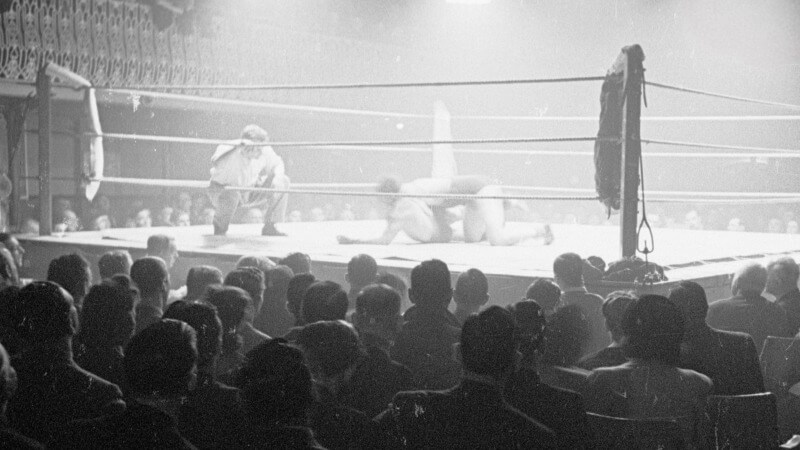
Photo by Felix Man/Picture Post/Getty Images
I’m a creature of habit. I’ve listened to the same music for most of my life. I’m not proud of that, but it’s the truth: I’ve clung to my favorites for decades, dragging them from format to format like a 30-year-old time capsule. They were on recorded cassettes, then burned CDs, then on all my iPods, and now they live on my streaming playlists. Same rotation, different hardware. I’d make a terrible DJ, but I like what I like. Don’t blame me, though. I didn’t discover my favorite bands thumbing through used vinyl at a cool record shop, or through the osmosis of hanging around older kids chain-smoking behind the town’s 7-Eleven. The foundation for my entire musical education—metal, punk, grunge, industrial, even hip-hop—instead came from one wild, unlikely source: a bunch of lunatics in a South Philly bingo hall.
When I was ten, I got a TV for Christmas—a 13-inch TV/VCR combo, to be exact. I don’t like to brag, but that felt very fancy in 1997. My bedroom didn’t have a cable jack, so I was forced to use an antenna to drag in whatever signals wobbled their way to the middle of nowhere, New Jersey. Most of the time, I’d watch a movie on tape or flip through the handful of channels that came in clearly, hunting for anything that wasn’t an infomercial. But one night, long past my bedtime, I landed on WGTW Channel 48 out of Philadelphia—on ECW, Extreme Championship Wrestling. Even at ten years old, I was already a lapsed wrestling fan—a former Hulkamaniac who’d drifted away right around the time Hulk Hogan left World Wrestling Federation (WWF) for World Championship Wrestling (WCW). It was kookier than ever. The gimmicks had become more cartoonish but less interesting. Everyone had a “thing”—the plumber, the garage man, the deranged dentist, the guy whose entire personality was that he worked a job other than wrestling. Characters you could understand instantly, which meant there was nothing else left to uncover. The nWo wasn’t in full effect yet, and the “Attitude Era” was still a few years away. I’d lost interest and didn’t believe I was missing anything.
I’d seen ECW mentioned in wrestling magazines, but the grainy halftone photos made it look like a low-budget WWF knockoff. Watching it proved otherwise within about three seconds. This was something else entirely. Louder, stranger, and infinitely more alive. ECW felt illicit. This wasn’t like WWF at all. The lighting was terrible, the camerawork was shaky, and the crowd looked seconds away from rioting. But the songs cut through everything. The wrestlers were making their entrances to real music, not generic themes cooked up in WWF’s corporate headquarters—no disrespect to Jim Johnston. These were songs that played on cool radio stations well outside my tiny Top 40 bubble. ECW’s musical world sounded bigger, messier, angrier. It sounded like real life.
And then that riff hit: “Enter Sandman.”
The whole crowd seemed to know what it meant. Then a guy with a protruding gut and draped in zebra-print Zubaz stormed through the audience with a cigarette in his mouth and a beer in his hand. It was The Sandman. The people weren’t cheering for this guy—they were paying respect by singing along to the music. To them, this wasn’t just a wrestler walking to the ring. It was a ritual—a crazy, 1,000-person karaoke session. And to me, sitting on my bed with the volume low enough not to stir my sleeping parents, it felt like the door to another world had just burst open.
My musical diet until that point was whatever was on pop radio, or whatever my parents played in the car. Metallica was a band I recognized from T-shirts worn by older kids who were definitely cooler than me. The energy of “Enter Sandman”—its tone, the lyrics—I’d never heard anything like it, and it sent me tumbling down the heavy metal rabbit hole: Sabbath, Motörhead, Danzig, Slayer, every heavy, scary, unhinged corner of music I could locate. Raven came out to the Offspring, which threw me into Bad Religion, Descendents, and Pennywise—an entire punk ecosystem I’d have missed without ECW. To this day, I know every word of “Natural Born Killaz” because it played on loop throughout every one of New Jack’s matches. ECW wasn’t just playing music, it was spoon-feeding me faraway genres one match at a time.
ECW owner, promoter, and mastermind Paul Heyman (yes, THAT Paul Heyman) truly had his thumb on the pulse of professional wrestling and whatever the hell was happening in ’90s culture. The product was raw, underground, gritty—the programming was the kind of production that looked like it was (barely) being held together with sweat, duct tape, and the collective willpower of everyone involved. It looked like real life. ECW wasn’t trying to define the ’90s. Instead, it reflected what the decade actually felt like and cranked it up to an 11. The entire era felt DIY, angsty, suspicious of anything overly polished. ECW didn’t try to clean anything up or package it nicely for a wider audience. Everything was amplified—Heyman held a funhouse mirror to the decade’s noise, palpable frustration, and low-grade chaos. If WWF was Saturday-morning cartoons and WCW was corporate sports with a pyro budget, then ECW was the random gathering of kids in every parking lot around the country—all coexisting in one place without anyone telling them they didn’t belong together. And the music was a massive part of what made it feel true.
It’s been 30 years. I recognize that nostalgia’s a hell of a drug—it’ll convince you that your memories carried more weight than they probably did. So, to make sure I wasn’t romanticizing all of this beyond recognition, I reached out and traded a few emails with the one guy who actually lived it: Harry Slash, ECW’s music coordinator, composer of the promotion’s iconic show-open song “This Is Extreme,” and leader of the Slashtones. His perspective confirmed everything I remembered. “It absolutely was a reflection of the times… Some fans discovered music for the first time on ECW programs,” he wrote to me. “The wide diversity of the music ECW used exposed fans to stuff they normally wouldn’t listen to. While it was more of a rock/metal fanbase, there were also goths, club kids, hip hop fans, country fans, and they would all groove to each other’s tunes. The entire (and often very diverse) audience would all sing ‘Enter Sandman’ together.”
The songs in ECW weren’t corny, homogenized, or corporate music written to accentuate merchandise lines. They were ripped straight out of the basements, bedrooms, and backseats of the times, not stuffy high-rise conference rooms. ECW’s soundtrack felt lived-in in a way the other promotions couldn’t kayfabe their way out of—“Because it wasn’t ‘fake’ generic music like WWF and WCW used. There were ‘real songs’ that fans had heard before ECW,” Slash said, bluntly. “It gave more of an illusion of realism.” And here’s the part that still feels crazy in hindsight: ECW could only use those “real songs” because Heyman just… used them. No licensing department. No negotiations. No legal team dotting i’s and crossing t’s. Heyman simply hit “play” on whatever song fit the vibe and worried about the consequences later—or, more accurately, didn’t worry. “Everyone knew it would be a problem,” Slash admitted. “But Paul didn’t care. He had the rights to some of the music we used, but for others, his stance was he’d keep using it until he got a cease and desist letter from an attorney.” This was ECW’s philosophy about most things: Do it until someone yells at you. And honestly, it worked—mostly.
 Keep scrolling for more great stories.