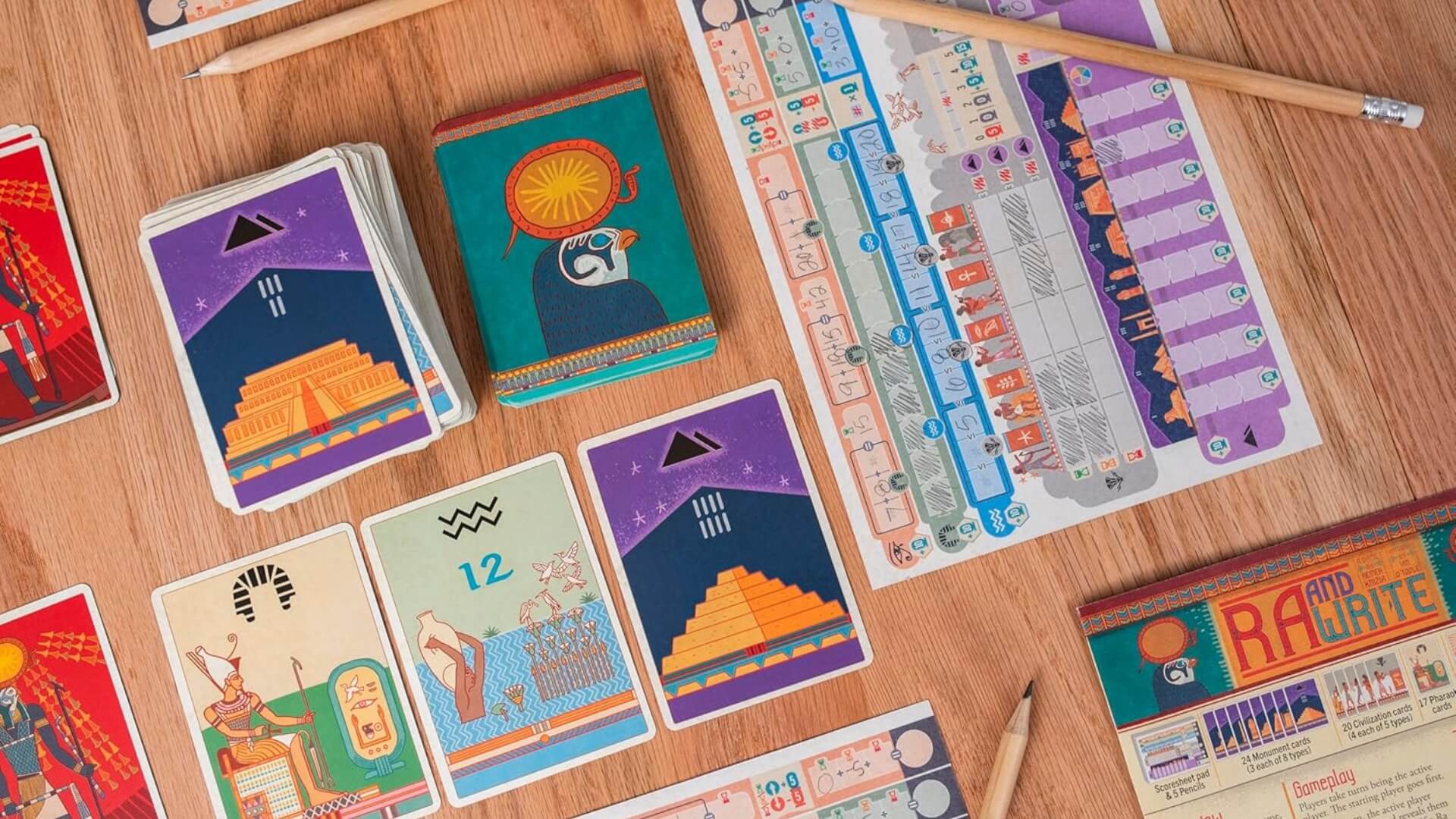
Four of the sections work in ways that will be very familiar to veterans of this style of game. For example: cards for the third row, the river, let you fill in the number on the card into the leftmost empty box on your sheet’s river, but only if the number is higher than the number to its left, something you’ll find in one of the Clever games. Cards for the second row just show that section’s symbol and you fill in the next box left to right, gaining points if you have the most boxes filled in there whenever there’s a scoring, and losing if you have the fewest. The fifth section, the monuments, is the most challenging, as there are eight distinct monuments, each with three spaces, and you can only mark off a space under a monument if one of its three matching cards is revealed—you can’t mark a Sphinx’s space with the Pyramids card, for example. There are two bonuses if you mark off at least one space in all eight monuments, but the biggest rewards come from completing all three spaces in one monument. Therefore, if you miss one of that monument’s cards, such as when the active player chooses it and you’re unable to do so, you have to try to finish it with one of the limited number of bonuses available.
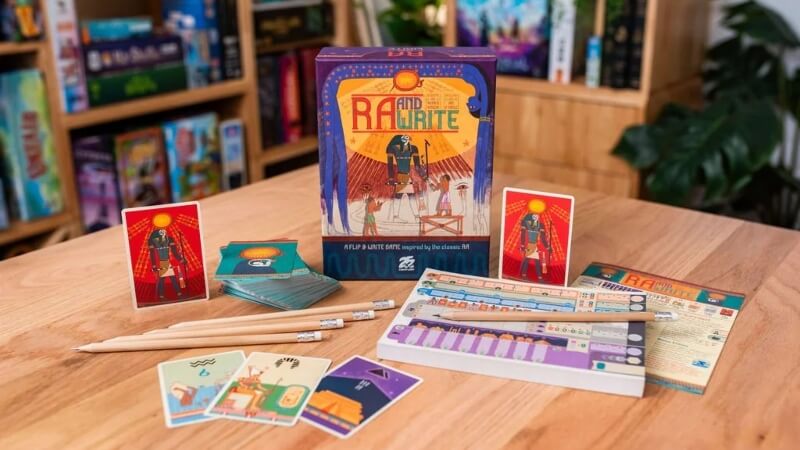
One aspect of Ra that’s missing in Ra And Write is the auction mechanic, which became a sort of early calling card for Knizia, the most prolific board game designer in the world. He had several early successes in the 1990s, including his tile-laying games (Samurai, still my favorite of his; Tigris & Euphrates) and his auction games (Ra, Medici). This game doesn’t feel a lot like a Knizia game, however, beyond the fact that it does “work”—his games are always done mechanics first and themes last, so nearly all of them play pretty flawlessly, and this one does as well.
I have two main issues with Ra And Write, although I think I’m in the minority here. One is that the game doesn’t offer many chaining bonuses, which is nearly always the best part of any roll/flip-and-write game. Those are bonuses you hit by filling in certain boxes, or getting far enough into a section to cross some threshold. Ra And Write has a few of those, but doesn’t have enough, and the ones it offers are very limited in what they allow you to do. The other is that the game’s length is too volatile; I’ve played this and had two Ra cards appear in the very first turn, at which point I just reshuffled because the odds were that the game was going to be way too short, and that’s no fun at all. I’d prefer a setup where at the very least you ensured that the last Ra card was in the final third of the deck.
Because the game is so simple, you could play this with anybody, even non-gamers, or kids who are at least old enough to add numbers together below 20. The game length is, as I said, unpredictable, but it’s going to be quick thanks to mostly simultaneous play and the absence of any complicated bonuses that require a lot of decisions, as you’d find in games like the Clever series or Three Sisters or French Quarter. I’d probably pick any of those ahead of this one, but they’re also all a higher degree of difficulty, making Ra And Write a better choice if you’re looking for something a little less luck-driven than Yahtzee and a little more fun than Qwixx while at that same level of complexity.


 Keep scrolling for more great stories.