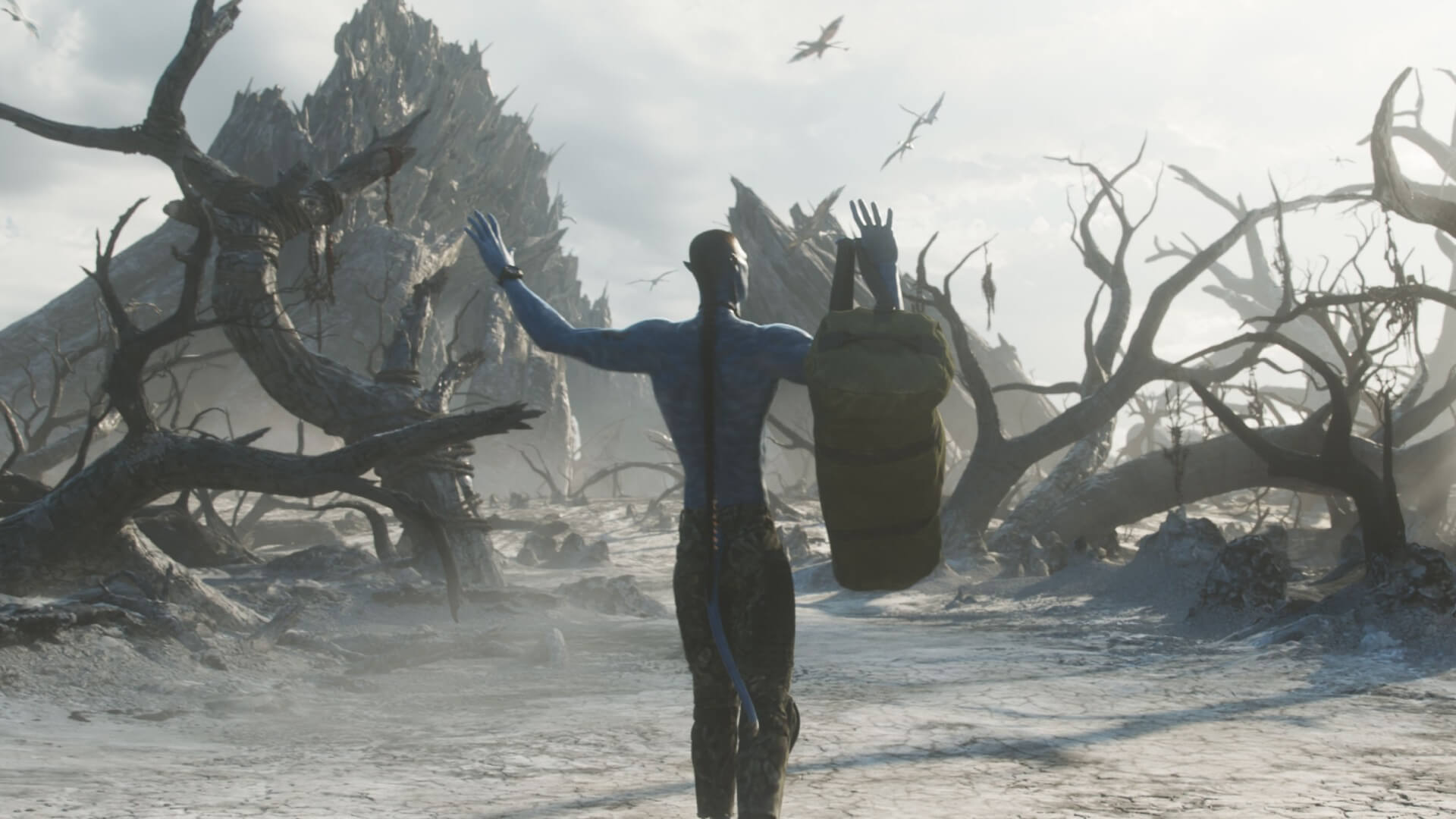
Cameron’s interest in technology has always been two-fold. Since The Terminator, he’s been at the forefront of visual effects, using them to tell grand stories of grander emotions. His characters often grapple with their relationship to technology and typically need to make peace with it before silencing an existential threat against the family. Aliens‘ Ripley must pilot a new mechanized body, the Powerloader, to defeat the Alien queen. In Terminator 2, a rebuttal to Cameron’s own fatalistic cyberpunk original, Sarah (Linda Hamilton) and John Connor (Edward Furlong) must form a nuclear family with her former predator, the T-800 (Arnold Schwarzenegger), to properly dispose of the T-1000 (Robert Patrick) and prevent a war with the machines. As if to put a point on his shifting attitudes, by the end of Avatar, a Na’vi, Neytiri (Zoe Saldaña), kills Miles Quaritch (Stephen Lang), the series’ sneering avatar of colonialism, decked out in a mech suit seemingly pillaged from Weaver’s old trailer.
By 2022’s Avatar: The Way Of Water, Cameron had further deemphasized the importance of tech on Pandora, focusing closer on the spiritual connection to his digital world. The avatar bodies are basically gone, replaced by hybrids of the natural and artificial. Jake Sully’s five-fingered children, the offspring of a natural Na’vi and an avatar body, become the focus, along with Kiri (Weaver), the immaculately conceived child of Dr. Grace’s (also Weaver) avatar. The late Colonel Quaritch, too, gets a transhumanist resurrection, with his memories permanently uploaded to an avatar he can’t escape. Most tellingly, the number of human characters is greatly reduced, mostly narrowing down to Quaritch’s son, Spider (Jack Champion), the boy raised by Na’vi—effectively, Cameron’s very own Mowgli.
In Fire And Ash, Cameron leaves the high-tech focus further behind, and goes even harder on both the spiritual and the human themes. Spider is the film’s MacGuffin, with his oxygen mask providing much of the first act’s tension. The film revolves around whether he’ll be welcomed into the Sully familial fortress, but first, he needs to learn how to breathe on Pandora. When his oxygen mask runs out of battery, technology can’t save him; only Kiri’s new powers can do that. Through a mix of prayer and botany, Kiri raises magical weeds from the forest floor, which enter Spider’s mouth and plant an endosymbiont deep inside his lungs. The nature of Pandora and the biology of humanity work together, giving him the ability to breathe again—as well as one of those magic dreadlocks that allows Spider to plug into Pandora’s flora and fauna. It’s this internal transformation that becomes the new unobtanium for the plot: If Quaritch gets to Spider first, and shows this scientific discovery to the military, it could be put to sinister use, supercharging humanity’s colonization efforts.
As Cameron devotes the rest of his natural life to these movies—one must assume there will be some Cameron-Bot making films long after he’s passed—he continues to indulge his cornier side as he’s aged. And this is the guy who ended Terminator 2 with, “I know now why you cry, but it is something I can never do.” With the Avatar movies, he’s added a spirituality that matches his crunchier beliefs, doing so through these CGI wonders. By deemphasizing the in-universe technology, Cameron removes the need for an audience surrogate who puts on his own 3D glasses. He doesn’t want the audience to think about jacking in and out of different bodies; he simply wants us to experience Pandora. Hence, in Fire And Ash, the idea of Na’vi getting a hold of advanced human weaponry becomes an existential threat, while the Sully kids seek help at the bottom of the ocean—a place Cameron has spent more time than almost any other person.
Cameron refutes his earlier films with these latest Avatar sequels, seeming less and less convinced by technology’s ability to bring people together. He wants Pandora and its films to be a unifier, a communal experience, one that’s welcoming to all people. He literalizes that with Spider—a human who’s literally becoming Na’vi on the inside—and by the end of Fire And Ash, he’s welcomed into the Na’vi’s spirit world not through technology, but his natural and spiritual evolution. It’s an arc that represents a full-circle moment for the filmmaker. “Because if a machine, a Terminator, can learn the value of human life,” Sarah Connor narrates at the end of Terminator 2, “maybe we can, too.” For all his incredible CGI, Cameron is finally investing in humanity first and foremost.


 Keep scrolling for more great stories.