With Women Of Action,Caroline Siede digs into the history of women-driven action movies to explore what these stories say about gender and how depictions of female action heroes have evolved over time.
Ang Lee is a romantic filmmaker. He makes literal romances like Brokeback Mountain and The Wedding Banquet, but there’s also a broader romanticism that colors his work. He’s interested in repressed emotions, quiet yearning, dutiful devotion, and natural environments that reflect the internal feelings of his characters. It’s the X-factor that helped make Crouching Tiger, Hidden Dragon such a massive breakthrough hit in the United States. The film’s grounded emotional drama gave Western audiences an “in” to a high-flying wuxia tradition they had never experienced before. 25 years ago, Crouching Tiger, Hidden Dragon became the first non-English language film to cross the $100 million threshold—kicking off a revolution in America’s willingness to “overcome the one-inch tall barrier of subtitles.”
That romanticism is equally key to understanding why Crouching Tiger, Hidden Dragon is one of the most singular female-led action films ever made. Traditionally, action is a “male genre.” When women exist in it, there’s a need to address why they’re there. To see them step into overtly masculine roles or defy patriarchal abuse or embrace their destinies as mothers or celebrate “girl power.” Even when a female character simply exists in an action movie—like Ellen Ripley in Alien—that in and of itself feels noteworthy. On a meta level, a woman in an action movie is always an outlier in some way; it’s the very idea this column is built on.
Romance, however, is traditionally a “woman’s genre.” There’s no need to explain why a woman exists in a romantic movie. It’s not notable when she’s surrounded by other women. And the idea of exploring her motivations, desires, and emotions is the very basis of the genre. It’s male-led romances like What Women Wantand Hitchthat need to thematically justify why men are at their center. It’s taken as a given that women deserve to be there. And that’s the quality that makes Crouching Tiger, Hidden Dragon so unique. Rather than an action movie with romance, Crouching Tiger is a romance with action. And that slight shift turns the entire energy of the film on its axis.
In fact, Lee specifically wanted to make “Sense And Sensibility, but with kick-ass.” He’d brought that Jane Austen story to life a few years earlier as part of a filmmaking career that hopped between his native Taiwan and the United States, where he went to film school. His early films were largely domestic dramedies, with one Western that had flopped the year before. With Crouching Tiger, Hidden Dragon, he wanted to fulfill his childhood dream of making a martial arts movie. And he specifically wanted to make a Chinese storytelling tradition accessible to Western audiences.
Logistically, Crouching Tiger, Hidden Dragon was an international co-production, funded by studios in China, the United States, Hong Kong, and Taiwan and featuring a diverse East Asian cast who had to learn new accents (and sometimes new languages) for the film. But it’s also international in its story sensibility. Traditional wuxia stories are historical fantasy tales steeped in themes of honor and chivalry, set in the mythical “jianghu” world of martial arts—sort of akin to Robin Hood or King Arthur stories in the West. Loosely based on a Chinese novel from the 1940s, Crouching Tiger evokes that tradition but reorients its story in a more intimate, domestic direction. Where traditional wuxia films open with an exhilarating action sequence, Crouching Tiger opens with 15 minutes of slow-burn world-building.
The filmoffers a traditional wuxia hero in Li Mu Bai (Chow Yun-fat), a legendary swordsman trained in the Wudang Mountains who has sworn to avenge the murder of his master. But at its heart, it’s really the story of a teenage girl caught between opposing forces. Jen (Zhang Ziyi) is a haughty governor’s daughter who is expected to marry the son of a prominent family to shore up her father’s political career. But she’s also a gifted fighter who was taught in secret by her governess Jade Fox (Cheng Pei-pei)—Mu Bai’s sworn enemy. In fact, Jen’s innate skill is so great that she long ago surpassed her master and can hold her own against just about any fighter she meets.
That makes Jen an explosive force everyone wants to model in their own image. Jade Fox wants her help to burn down the patriarchal forces of the martial arts world. Mu Bai wants to take her on as his student. Her ex-lover Lo (Chang Chen) wants her to run away and live a bandit’s life with him. And dutiful swordswoman Shu Lien (Michelle Yeoh) encourages her to follow her family’s wishes rather than defy her role as a woman and daughter. Crouching Tiger, Hidden Dragon isn’t really built around themes of good vs. evil, it’s driven by the question of what Jen wants for her life and whether it’s possible to achieve it.
Women had led wuxia films before, including Pei-pei’s 1966 classic Come Drink With Me and Yeoh’s early Hong Kong action career. But the framing of Jen’s story feels unique. The romance genre often smuggles women’s self-actualization stories into “which path will she choose?” narratives. Crouching Tiger, Hidden Dragon does the same, with action scenes that are as much metaphorical character beats as literal fights. When Jen is at her most recklessly confident, she can take down an entire restaurant of martial artists with playful abandon. But when she’s confused and unsure, her bamboo forest fight with Mu Bai feels abstracted and disorienting—more dreamlike than hardhitting.
It’s a concept that made for a tense set at times. Lee had never made a martial arts film before and hired legendary Hong Kong action choreographer Yuen Woo-ping (then fresh off The Matrix) to stage the fights. But their philosophies didn’t always align. Yuen came from a tradition where the goal was to make the coolest, most innovative action sequences possible. As Lee told Entertainment Weeklyin a 20th anniversary retrospective, “I talked about acting, which was a real bother to him.”
“We all had to sacrifice a lot,” Lee explained. “I had to sacrifice drama sometimes, and he had to sacrifice beautiful action for the dramatic effect.” That probably explains why the film wasn’t a hit in China, where audiences expected a different level of wuxia action. Still, Lee credits Yuen too: “I learned from those guys not only choreography, but pure cinema. What works for movies, cinematic sense, camera movement, editing, a lot. It took me two, three months to get an idea of what they do and what to look for. I learned to respect that, and I still try to bring what they do [to my films].
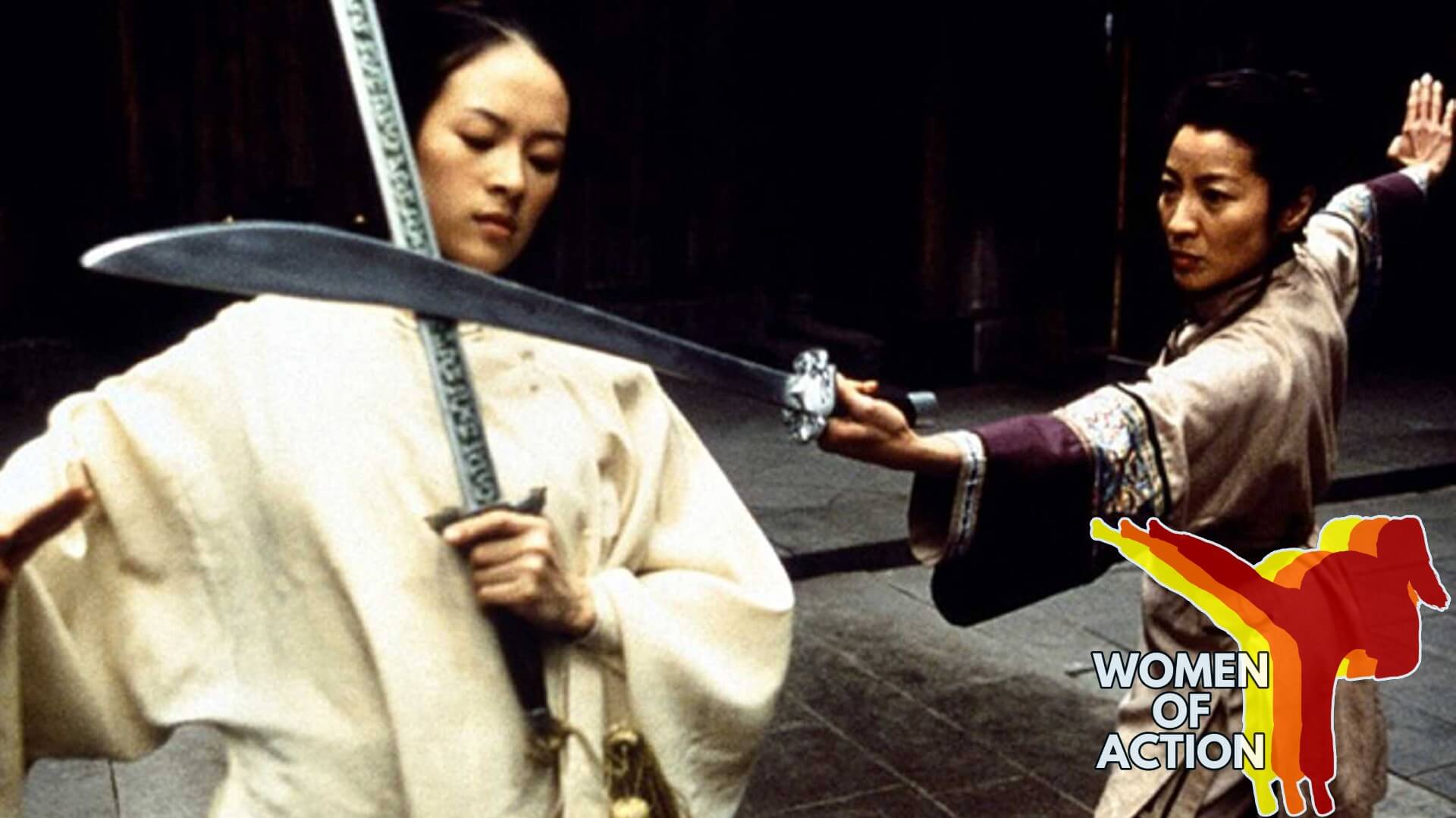
So much of that “pure cinema” exists in the fight scenes between Jen and Shu Lien, the film’s most fascinating foils. They lead the first action sequence—a thrilling, drum-scored aerial rooftop battle. They also deliver what feels like the movie’s action climax, even though there’s technically a whole act still to come—a balletic sword fight where Shu Lien has to keep finding new weapons to match Jen’s stolen Green Destiny sword.
What both fights understand is that there’s a natural kinship between Jen and Shu Lien, two women steeped in otherworldly martial arts. When Jen first meets Shu Lien, she immediately declares that they should be sisters. And Shu Lien never entirely loses her instinct to look after the younger fighter, even when she’s deeply frustrated by her. Yet, in other ways, the two women couldn’t be more different. For Jen, marriage represents the ultimate curtailing of her freedom. For Shu Lien, however, the ability to marry would be the ultimate act of freedom. She and Mu Bai have quietly been in love with each other for years, but they refuse to act on their feelings because she was engaged to his best friend before his death and that would dishonor his memory. Jen assumes Shu Lien’s single woman life must be one of complete liberation, without realizing she’s just bound to a different kind of societal pressure.
While defiant Jen and bitter Jade Fox are more familiar female action hero archetypes for American audiences, Shu Lien is more unique to the wuxia one. Jade Fox had to steal her martial arts skills from the Wudang masters who refused to train a woman, even after they’d slept with her. And Jen’s natural martial arts prowess reflects her plucky rebellious streak. But though there are hierarchies to the jianghu world, it’s not as simple as “men are allowed to fight and women aren’t.” In fact, it’s treated as perfectly normal that Shu Lien is a highly skilled fighter who runs her own private security company—so long as she follows the same chivalric code as Mu Bai.
In that sense, it matters that Jade Fox, Jen, and Shu Lien are women, but it also doesn’t. They are fighters bound by forces that sometimes have to do with gender and other times have to do with class or honor codes or age or politics. Where the action genre thrives on simpler archetypes (“the final girl,” “the chosen one”), the romance genre is more interested in how three-dimensional people exist within emotionally complicated realities. Crouching Tiger, Hidden Dragon takes a “best of both worlds” approach to blending the two.
There are no real heroes and villains to its stories, nor real winners and losers to its fight sequences. The action is exhilarating, but as in a romance, the final climax is rooted in emotional revelations. Jade Fox dies realizing she’s spent her life living in poison. Mu Bai uses his final breath to confess his love for Shu Lien and his regrets about putting duty above his feelings. Jen finally comes to understand there can be deadly consequences to her petulant actions. And Shu Lien lets go of her rage and encourages Jen to walk her own path in life. The film’s ambiguous final scene evokes both self-determination and self-sacrifice all at once—we don’t know exactly what Jen has chosen, but we do know that she’s chosen it for herself. That’s what matters.
These days, Crouching Tiger, Hidden Dragon is best remembered for its East-meets-West fusion. The film kicked off a brief run of crossover wuxia hits like Hero and House Of Flying Daggers, and it helped transform the idea of a “foreign film” from arthouse fare to something that felt accessible to mainstream moviegoers. But of all the film’s trailblazing accomplishments, it’s the balance of romance and action that still feels most unique. As much as any action film ever made, Crouching Tiger treats it as a given that women deserve to be there—not in a self-congratulatory way, but in a matter-of-fact one. That’s a high-flying thrill in its own right.
Next time: Demi Moore proved her mettle in G.I. Jane.


 Keep scrolling for more great stories.