For all his everyman qualities, [Gene] Hackman knew how to play hedonistic, and, in the case of Royal Tenenbaum, remain likable. But arguably his greatest performance was one of abstention, of removing all signifiers of a life until what was left could hardly be described that way. In The Conversation, wiretapper extraordinaire Harry Caul fervently guards his privacy because he knows what men like him are capable of discovering. He refuses to inquire about his client’s motives or even acknowledge that they exist, focusing instead on delivering high-quality results. His latest case, gathering surveillance on a couple (Cindy Williams and Frederic Forrest), puts the lie to that belief. At one point, seeing that he’s become overly invested, a character admonishes him about his work: “You’re not supposed to feel anything about it. You’re just supposed to do it.” Harry’s avoided cultivating a life that someone might want or be able to take away. He fails to understand the real intent of the conversation he captures because he can’t identify with their desires, their wants. In the end, it’s a fatal misinterpretation. [Danette Chavez]
No one plays awful or awfully oblivious quite like Parker Posey (March 12)
Some have slighted this season of Mike White’s show as less impactful or pointed than previous ones, but any series that introduces a Lorazepam-sloshed and dumbly grinning old-money North Carolinian with the line “We flew over the North Pole” in that brilliant and thick Southern accent can’t be even remotely bad. It’s a treat just to see Posey do her thing on-screen each Sunday night. “I was also a Tar Heel,” she announces, referring to her embarrassed daughter, Piper (Sarah Catherine Hook), in that aforementioned intro. “But Timothy went to Duke, Saxon graduated Duke, and Lochlan, our youngest, just got accepted to both. So you can imagine, it’s a whole thing.” Watching the hotel’s general manager, Fabian (Christian Friedel, this season’s other comedic MVP), take this all in, confused, as Victoria wraps up as if it’s the most interesting anecdote is a joy to behold. [Tim Lowery]
Studio Ghibli faces its biggest villain yet: an ironic onslaught of AI (March 27)
In the documentary The One Who Never Ends, Miyazaki continues his thoughts on AI art with statements nearly as apocalyptic as those in Nausicaä. “I feel like we are nearing to the end of the times,” he says. “We humans are losing faith in ourselves.” No longer seeing art as work, as something worth putting effort into, a vast audience now has no faith that it can create anything of its own. Instead, this audience is more than happy to shove the movies it loves—movies currently returning to the big screen as animation’s gold standard—into the meat grinder, for no other reason than because it’s easy to do so. If the villains in Ghibli movies were that vacant, the films would never have become classics in the first place. [Jacob Oller]
Tituss Burgess makes Mary Todd Lincoln his own (April 1)
[Oh, Mary!] may have found some longevity, should it continue to reimagine the style and skills its lead must bring to the role. Escola’s a good actor, but Oh, Mary! is so written in their voice that it almost started to feel unscripted, as if they were just saying whatever popped into their head. When Burgess takes on the part, it’s still written in Escola’s voice, drawing more attention to the writing and thus the theatricality of the whole endeavor. But casting a performer known for his theatricality not only pays off, but increases the depth of the character. Burgess’ Mary seems most natural in the moment where she’s explicitly performing; it was the role of First Lady that was more ill-fitting. [Drew Gillis]
Val Kilmer never shot straight (April 4)
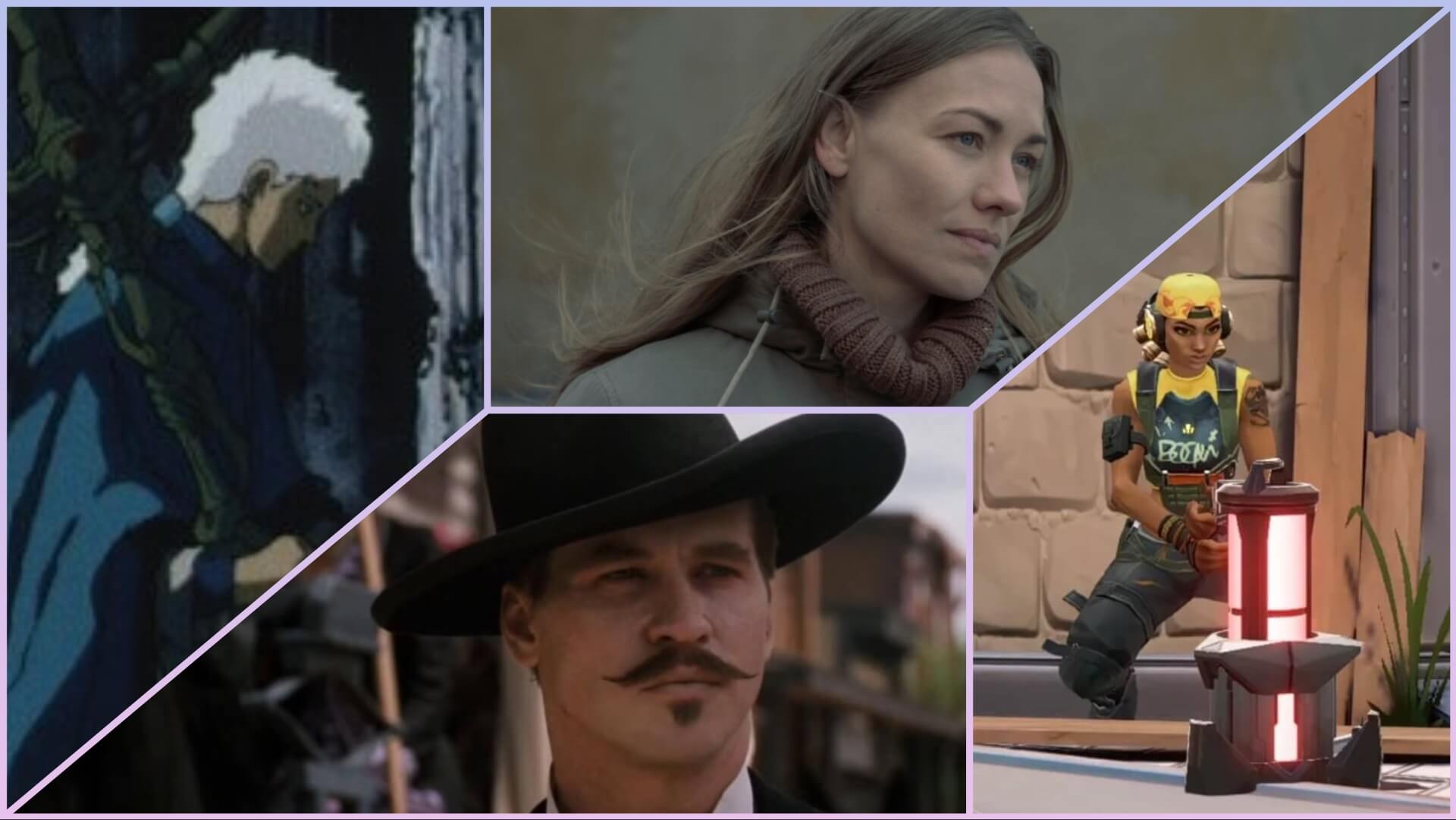
Val Kilmer was not a movie star. That’s just what we called him. The late actor definitely starred in a lot of movies. Big movies, the kinds built around big names, sex appeal, and action, which put his name right at the top of the poster. He was Batman, he was Iceman, he was Jim Morrison. Val Kilmer, in his prime, meant box office dollars in a way that said “movie star” to the industry.
But for all his charm, good looks, and million-dollar smiles, Kilmer sought to subvert his own movie star persona, always looking for the most creative way to perform the most straitlaced roles. Even when playing to his largest audiences, with grand budgets and costumes and all the trappings of superstardom, he slapped his expanding belly as Jim Morrison, snapped his teeth at Tom Cruise as Iceman, contrasted Joel Schumacher bombast as an icy Batman. Kilmer was always digging for the unexpected honesty in his characters, no matter how airbrushed and perfect his surface looked on screen. [Matthew Jackson]
The reaction to Sinners‘ opening lays bare the racial bias around Black blockbusters (April 24)
Usually, a film that has a great debut like Sinners would get some celebratory coverage from the trades and online sites. But, even though it’s another certified blockbuster that’s keeping the lights on at Warner Bros. (Minecraft is also a WB picture), some outlets have been downplaying its obvious success. The New York Times reported that, despite its opening weekend haul, it still has a long way to go to break even at the box office. Variety made the same quibbles on X. Vulture has been the most blatant in covering Sinners‘ financial journey, even dropping a post-weekend piece titled “So Is Sinners Going to Make or Lose Money?” (Jesus, can Black folk do a victory lap before we get to the numbers-crunching?) [Craig D. Lindsey]
Jason Mantzoukas on setting out to be Taskmaster‘s Ugly American villain (May 3)
On Taskmaster crossing over: “I think what you’re asking is specific to Taskmaster, but also making a larger point, which is America doesn’t do panel shows. One of the hardest things I’ve had in trying to get people excited about the show, or even before I was even on it, years ago when I was trying to turn people onto the show… Boy, for such a dead simple show, it is so hard to explain to people what it is and why they might like it. What’s hard is a few things. First, panel shows exist over there; they hold a middle ground wherein a lot of stand-up comedians, specifically, their kind of proving ground, the way they get known or get exposure, is on panel shows. That generation, Nish and Aisling Bea and James Acaster and Ed Gamble and all those folks, their ascendancy, a lot of it is through all the myriad panel shows there. Would I Lie To You?, Celebrity Mastermind, Taskmaster, all these shows that showcase comedians not doing material. That’s the point. It’s not doing stand-up sets.” [As told to William Hughes]
The Handmaid’s Tale‘s otherwise satisfying final season was marred by Serena’s ending (June 1)
Throughout its run, the award-winning series revolved around June’s dedication—no, rightfully rage-driven obsession—to survive, save her daughters, and help other women trapped in a patriarchal regime. As a reminder, THT is set in a future where environmental disasters have led to very low birth rates. So the top Gilead commanders, after taking over the U.S. government in a coup, enslave fertile women to forcibly impregnate and then separate them from their children. Serena is not only complicit in helping Fred take advantage of June, but her pre-Gilead work as a famous conservative public speaker and author helped spearhead and promote ideas of stripping away women’s rights. Ironically, she eventually lost autonomy in the very system she helped create. [Saloni Gajjar]
Rick And Morty can’t seem to find a reason to rage against the machine (June 2)
While Rick And Morty has always been playing with its own self-awareness—parodying tropes, breaking the fourth wall, referencing its peak-era episodes with almost pathological nostalgia—season eight, which kicked off May 25, arrives at a strange emotional impasse. Rick finally got his revenge in season seven, beating Rick Prime, the multiverse-hopping murderer of every incarnation of his wife Diane, into a puddle of blood, gristle, and closure. And without that vendetta animating him and the beloved show, Rick And Morty is forced to ask: What now? [Leila Latif]
Come And See is a poster child for shock films, but its reputation misses what it’s really about (July 7)
While often seen simply as a polemic against the horrors of war, the film still fits neatly into a culture that has itself created a modern, never-ending meat grinder for human life. But, unlike how scenes from Apocalypse Now have been co-opted to make points counter to what the film is trying to say (think the young Marine recruits in Jarhead cheering to the “Ride Of The Valkyries” sequence), Come And See is instead a film masquerading as purely anti-war through its formal conceits, which distract modern audiences from its militarist context. That is to say, despite its recent perception and popularity, Come And See should not be viewed as the be-all-end-all of war films, but as a single, specific, and culturally contextual perspective on World War II. Its visceral experiment in conveying the horrors of war is successful, but maybe too successful given how that has led to the film being reduced to something upsetting that content creators can react to. [Alex Lei]
Ari Aster is just asking questions, like “How the hell do we get off this thing?” (July 16)
On Eddington: “I wasn’t writing this from a remove. There are people in my life, who are very important to me, who are living in totally different realities. I can’t really reach them, and they can’t really reach me when it comes to any kind of conversation about what is happening. We all care about the world, we’re all worried about it, but we’re not in agreement about what the problems are, and what the sources of the problems are. That’s heartbreaking to me. I really wanted to make a movie about that environment. To pull back as far as I could and include as many voices from the cacophony as I could, without sacrificing story. The experiment became ‘Can I make something coherent that is about the incoherent miasma?'” [As told to Jacob Oller]
Dexter: Resurrection repairs a once-great franchise’s legacy (September 6)
There was little reason to think that [Dexter: Resurrection] would work. It’s not just the spin-offs that have been a bit disappointing; the last few seasons of the Showtime original weren’t exactly critical blockbusters as the show seemed lost in its efforts to top the award-winning peak of its fourth season. So how did the writers of this unexpectedly clever thriller—Phillips, Scott Buck, and Kirsa Rein, among others—pull off Dexter’s greatest assignment? They got back to the basics: high-powered guest stars, righteous justice, and captivating twists and turns. And they did so through mirror images of what fans of this show know about its characters, reflecting the themes that built the series’ legacy in the first place. [Brian Tallerico]
Andor‘s Tony Gilroy talks revolution, propaganda, and navigating Star Wars cartoon canon (September 12)
On the series’ real world elements: “[O]n the flip side, the Empire is not just blowing up Alderaan, which is an abstract idea. It’s literally sniping people in the town square. All the heinous things are just as small and just as real. You don’t get one without the other. We’re trying to make it all, in the end. What’s the equivalent? You can have a hospital show where you’re, you know, 50 miles away from the operating room, and you’re talking about malfeasance in the administration. Or you have another one that’s taking you down into the operating theater and showing you where it happens. We’re going as low and molecular and as specific as we can. Everybody’s behavior is gonna come under scrutiny. And this is what revolution looks like. Welcome to the rebellion.” [As told to William Hughes]
Robert Redford weaponized his good looks to disarm us in every genre (September 18)
At first blush, you might not think an actor as impossibly handsome as [Robert] Redford would have access to vulnerable feelings like that. But—despite the infamous anecdote about him being turned down for the lead role in The Graduate because Mike Nichols couldn’t believe that a woman had ever rejected him; “I never did look like a 21-year-old kid just outta college who’d never been laid,” Redford quipped—he of course did. He was both a human being, and a terrific actor well aware of his natural gifts. He used his perfect exterior as a formidable tool in his actor’s kit, to illustrate the vast gulf there is between the face we show to the world and the tumult inside of us. [Chloe Walker]
Just like Star Wars fans, pinball can’t let the past die (September 25)
There’s a palpable sense that Stern knows it’s treading into brackish, over-familiar waters here. When some of the company’s PR folks pulled me aside for an interview about my experience with the new table, the last question they asked me was how Fall differentiated itself from Star Wars 2017, which I mostly mumbled some polite non-answers to get through. In his presentation, Davis noted that he’d actually had to fight Disney to let the company give the table its subtitle, rather than just call it Star Wars again. There are only so many pop culture touchstones buried in 90 percent of Americans’ brains, and Stern seems to know it’s tapping a very similar button to one it hit less than a decade ago—if not engaging in outright self-cannibalization. [William Hughes]
Roofman director Derek Cianfrance is “always going to choose love over money” (October 13)
On the American dream: “There’s a version of this movie that, when we were writing it, we were thinking about: ‘Are we going to make a movie that’s a satire about what society breeds? Are we going to make a movie that’s a takedown of capitalism, of this culture that makes people crazy like that?’ And I felt like it wasn’t going to be true to Jeff or really true to my heart. Jeff desperately wanted to fit into that society. He just couldn’t. He never judged it. He never thought about American capitalism and corporations, but he did know he wasn’t going to steal from mom-and-pop stores, right? He thought to himself, ‘McDonald’s can handle it: billions of customers served, billions of dollars, and who’s going to miss it?’ He wasn’t going to really hurt anybody, because he would never really hurt anyone, and he was going to give them their jackets as he put them in the freezer. What he realized later was that he did hurt people—not physically, but emotionally and psychologically.” [As told to Isaac Feldberg]
Vince Gilligan really doesn’t want to help you prepare for Pluribus (October 28)
On the streak of loneliness that runs through his work: “I relate to people who feel like outsiders. I think we all do. I often say, ‘Oh, I’m a lone wolf. I get what it’s like to be an outsider.’ Hell, everybody does. Everybody feels like that. There might be billionaires out there who feel like underdogs because everybody loves underdogs, everybody loves Rocky Balboa. Human beings like to see themselves like that. Sometimes I walk into a restaurant, and I get this feeling that everybody knows each other, and I’m the only one who’s a stranger. That’s a very human feeling. So I like a hero who is not fully equipped for the task. Carol Sturka wants to save the world, but it doesn’t necessarily need to be done by her. She doesn’t need the credit. She just assumes someone else will take the reins of this thing. She’s not fully equipped to do it. In the show, it’s not at all clear that she will be able to do it. It’s not even necessarily clear that the world needs saving. Those are the kind of stories I like, where the audience can say, ‘You know, I don’t know if she’s even doing the right thing. I know her heart’s in the right place, but is she even doing the right thing?'” [As told to Saloni Gajjar]
How can you shock audiences in 2025? Some filmmakers turn to AI (November 3)
But it’s impossible to blame the audiences. In North America, at least, all we ever hear about artists and generative AI is from hostile tech types who take no small joy in announcing that hey, artists might think they’re better than us now, but they won’t be so smug when we’ve automated them out of existence. A sneering contempt for community, hard work, and passion aside—something that those against AI oppose as much as the technology’s environmental impact and built-in tendency towards plagiarism—big tech also has a financial interest in making us believe that AI is unavoidable. They have a product to push. [Katie Rife]
Cracking Angel’s Egg is a fool’s errand, but let’s try anyway (November 27)
But why is it that this brief 71-minute flick has continued to enrapture and beguile, ensnaring countless viewers in its dark fantasy daydream decades later? The most straightforward answer is how it uses sumptuous visuals to deliver a monochrome gothic world of sights that excite the imagination. Its imagery is bizarre and naturally invites curiosity: pulsing organic tanks, abandoned cobblestone street corners, a floating mechanical eye emerging from bubbling sea foam. Some have described it reductively as “what would happen if Tarkovsky directed an anime,” and while that isn’t quite right, it does share a penchant for patient camerawork and dense imagery that very much feels like “sculpting in time.” [Elijah Gonzalez]
Dropping Apple Music saved me from becoming a lean-back listener (December 12)
Telling people you quit streaming is the modern equivalent of “I don’t own a TV.” It might not help at parties, but taking charge of my listening habits has also reignited my relationship with music, making me more enthusiastic about what I listen to and more likely to sit with things that don’t immediately click. The albums are the same, but on streaming, there’s no friction between acquiring an album and listening to it. Low-effort acquisition led to low-effort consumption, and as soon as I put even the slightest bit of work into it, I found more to love. Reading liner notes, admiring album art, and loading a CD into the $30 burner we bought after canceling all made a bigger impression than replaying the same tired playlists I would turn to when decision paralysis made choice impossible. After all, a smaller collection is more welcoming to the lost art of letting an album grow on you. If I took the time to seek out music, be it at the library, the record store, or on Bandcamp, I would be more likely to connect with it. [Matt Schimkowitz]
The only thing worse than bad AI music is good AI music (December 17)
The ordeal is an unwelcome confirmation of a reality we’re trying to shake like a bad dream: AI-produced music is real, it’s imposing, and in 90% of cases, it’s egregious garbage. The remaining 10% is where things get complicated. Because before anyone suspected anything, people loved [“I Run”], and not in the ironic way the internet sometimes turns generated clips of chaotic Grammy moments and toddlers posing as Bravolebrities into viral hits. They loved it the way you love a song that finds you at exactly the right moment. In turn, listeners helped it reach certain success, right before they felt the rug-pull of deceit. That whiplash, from genuine enjoyment to retroactive rejection, encompasses the real questions at the core of this: What happens when you actually like the AI slop? How can you fight against something when you aren’t even aware that you’re in a fight, especially when the music industry’s largest distributors aren’t really incentivized to fight alongside you? [Shannon Miller]
Distracted gaming: Why nobody pays attention in multiplayer games anymore (December 20)
When every single diversion is designed to take up all of your time, it’s impossible to feel like you aren’t constantly missing out. The sheer amount of content out there has piled up so inconceivably high that it can feel like the only way to make a meaningful dent in it is by cutting corners—by watching TikTok while also playing Overwatch.
As short-form content consumption rises and the black hole of free-to-play games yawns ever-wider, double-dipping screens worsens, as I’ve seen firsthand. Valorant is no longer entertaining enough to keep me or my squad mates from the siren call of tabbing out; my dopamine-starved brain just can’t stomach the thought of waiting, like, three whole minutes to get a kill without snacking on a Bluesky post first. [Bee Wertheimer]


 Keep scrolling for more great stories.