
Jim Jarmusch poked holes in the hero worship of Elvis with Mystery Train
On Elvis Presley’s birthday, we dive into a film preoccupied with The King, his music, and his influences.
Photo: The Criterion Collection
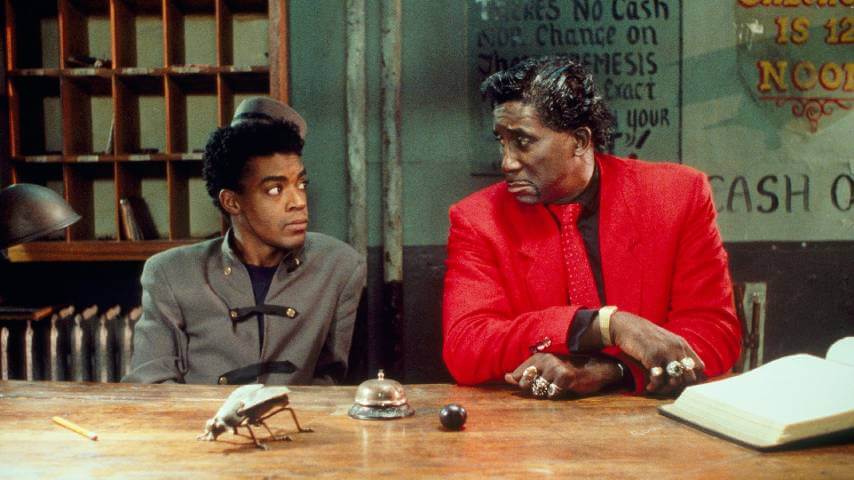
Released in November 1989, Jim Jarmusch’s Mystery Train is seen as the final installment in the deadpan, hard-luck trilogy he began with 1984’s Stranger Than Paradise and continued with 1986’s Down By Law. It’s a journey Jarmusch started with actor-musician John Lurie, who not only starred in Paradise and Law, but also composed their scores. (He also appeared in and did music for Jarmusch’s 1980 debut Permanent Vacation.) Mystery Train—a three-chapter anthology of pre-Tarantino pulp fiction—marked Lurie’s last time scoring for Jarmusch. Set in Memphis, it’s certainly the most musical of Jarmusch’s ’80s indie operas. The filmmaker once again gathers an ensemble cast of cult musicians, offbeat character actors, and international special guests to play lost souls wandering around this crazy land. Along with Lurie’s bluesy compositions (which accompany scenes of characters walking through the more urban parts of Memphis), the Mystery Train soundtrack also includes oldies-but-goodies from soul and rock artists who spent some career-launching time in the home of the blues and birthplace of rock ‘n’ roll.
But since this film is called Mystery Train, it must first start off with The King. Elvis Presley’s star-making, rockabilly rendition of Junior Parker’s blues song “Mystery Train” is heard as the film introduces Mitsuko (Youki Kudoh) and Jun (Masatoshi Nagase), the protagonists of the triptych’s first story, “Far From Yokohama.” These Japanese teenagers are first seen on a train, listening to the tune on a Walkman. They’re on a pilgrimage to visit Sun Studios, Graceland, and other Elvis landmarks in Bluff City.
Talk of Elvis Aaron Presley is never too far away in Mystery Train. Mitsuko can’t stop gushing about him. (Her hepcat boyfriend, on the other hand, prefers Carl Perkins.) In the second story, appropriately titled “A Ghost,” a skeevy con man (Tom Noonan) tries to get money out of a visiting Italian widow (Nicoletta Braschi) by telling her a tale involving Presley and a keepsake that the icon allegedly gave him to pass along to her. The final installment, “Lost In Space,” features English punk royalty Joe Strummer as Johnny, a snotty, heartbroken, recently fired British greaser (nicknamed “Elvis” by his co-workers) who ropes in both his friend (comedian Rick Aviles) and his brother-in-law (a very young Steve Buscemi) for a night of robbery, gunshots, and excessive drinking.
 Keep scrolling for more great stories.