
Ginny & Georgia review: season 2 needs more Ginny, less Georgia
Netflix dramedy Ginny & Georgia returns with more Gilmore Girls-esque maternal drama—and even more murder

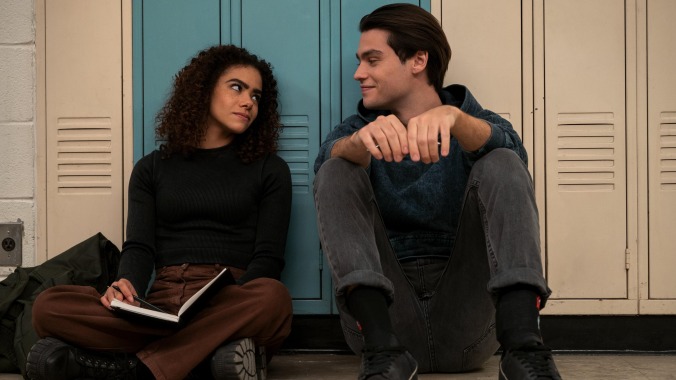
“It’s just so fun to hate Ginny,” the self-referential teen of the titular duo of Ginny & Georgia says with a mocking tone early on in season two. But we don’t hate Ginny (played by Antonia Gentry, nailing that adolescent mix of grace, gawk, and grouch). If anything, we wish it was more fun to hate Ginny & Georgia, the murder-mystery mother-daughter dramedy that returns to Netflix with 10 new episodes. There’s a lot to like when it comes to Ginny and Georgia Miller (Brianne Howey), and the quaint town of Wellsbury, Massachusetts, that they relocate to—along with Ginny’s little bro Austin (Diesel La Torraca)—following the mysterious death of Georgia’s husband last season. The problem is there’s just too much of it.
The Gilmore Girls comparisons were near constant when the series debuted in February 2021. The surface-level similarities were accounted for: the bright, bookish teen daughter, the magnetic 30-year-old single mom, the postcard-worthy New England town, and the penchant for alliterative titles. However, particularly in its second season, Ginny & Georgia suffers where that early-aughts charmer succeeded—knowing exactly what kind of show it is. The Gilmore women cozily and confidently occupy an entire TV genre, one lovingly suffused with small-town quirks, pop-culture quips, and the atmospheric “la-las.” It’s less a show and more “a lifestyle, a religion”—but the Miller ladies are tasked with leading several programs all at once: issues-driven YA series, gritty family drama, high-concept crime thriller, and suburban soap, to name a few.
Take for example one of Georgia’s rants in a frustrated moment of parenting in season two: “Sneaking a boy through a window. Am I trapped in a ’90s show? What is this, Dawson’s Creek? What’s the next episode? Someone has a mental breakdown or hooks up with a teacher?” Not even two minutes later, she joins Ginny for a therapy session, claiming: “This is just like The Sopranos.” Ironically and jarringly enough, Ginny & Georgia regularly veers into both lanes, abruptly gear-shifting from relatable scenes of Ginny gabbing about boys and rebelliously dying her hair, to her mother, you know, killing people.
Despite the pulpy intrigue of Georgia’s considerable criminal history, the series—created by Sarah Lampert and showrun by Debra J. Fisher—is far more compelling when it follows the adventures of the younger Miller. Season one shallowly touched upon Ginny’s struggles with self-harm and her biracial identity (see: the viral and cringe “Oppression Olympics” smackdown between Ginny, who is half-Black, and her half-Taiwanese friend Hunter last season). The sophomore season gratefully and sensitively digs deeper into the storylines.
 Keep scrolling for more great stories.