The human impulse of SML is impossible to replicate
The Best of What’s Next: The LA quintet is full of freakout code-writers tethered to the madness of kosmische, house, acid, Afrobeat, and techno chaos, where theory and feel get synthesized into mind-melting overtures of pedal tones, modules, and DAWs.
To find SML’s beginnings, you have to go back to ETA, a cocktail bar in the Highland Park neighborhood of Los Angeles. The space opened in 2016, thanks to the work of James Bygrave, Ryan Julio, and Matt Glassman. Julio was especially influential in allowing bands and players to “try things out” at the bar. The goal wasn’t “selling the most tickets,” but establishing a community-focused, music-driven venue. There aren’t many places like that here anymore—the Griffin in Atwater Village got renamed the High Low Bar and the Blue Whale didn’t make it out of COVID, though there are plans in place for it to re-open soon. “ETA seemed like it had carved out a niche for itself as a place for creative music,” guitarist Jeff Parker says. “Jazz is a very marginalized community in a place like LA, the entertainment hub of the Western world—commercial music being a big part of that.” ETA, thanks to Julio and Parker, helped to forge an identity for Los Angeles radicals, for musicians relocating to Hollywood from New York or Chicago.
For seven years, Parker and his IVtet—saxophonist Josh Johnson, bassist Anna Butterss, and drummer Jay Bellerose—were doing gigs at ETA almost every Monday as a way “to keep myself busy and keep my brain and my chops together” upon Parker’s relocation to Los Angeles from Chicago. It was his new Rodan. Jeremiah Chiu, a brilliant synthesist who’d left Chicago in 2014 and sought out spaces “that program the way that Ryan was programming” upon his arrival in Hollywood, went to those initial IVtet gigs in 2017—when there were only ten people in the audience watching “some of the most incredible people playing music today.” It was a place he’d go to see musicians hanging out with musicians, or to meet deep music lovers who’d stopped by for a glimpse at that special weekly thing. Low crowd totals didn’t negate the work being done to cultivate the ETA community.
Eventually, Julio and Bryce Gonzalez started recording all of the IVtet’s sets—an “exercise for himself,” as Parker puts it. “I think Bryce brought some of this stuff into the public sphere because he was archiving it,” Chiu explains. “And had it not been archived and recorded and people were able to hear those recordings, I don’t know that people would be talking about it the same way.” Once Mondays at the Enfield Tennis Academy dropped in 2022, more folks started tuning in. “Suddenly, there were a bunch of people there who none of us had ever seen before, and they were young,” Butterss says. “They were a bunch of 22-year-olds who were really excited.” Parker concurs, remembering how “every time we played, man, the place was jam-packed. There were lines down the block.” It was serendipitous and mostly happenstance—not only that a community and a scene had grown around Parker and the IVtet, but that Gonzalez had documented it all to boot.
SML was born out of that documentation—out of the work that Parker, Butterss, Bellerose, and Johnson had put into ETA for a near-decade. Chiu and guitarist Gregory Uhlmann had been talking about playing together for a long time, and Julio set aside two nights at ETA for them in late 2022. On night one, it was a trio of them and Johnson. The next night, it was a quartet of Uhlmann, Chiu, Booker Stardrum, and Butterss. Six months down the road, the five of them returned to ETA and did four shows together, eventually turning the recordings into a debut album, Small Medium Large—which was captured by Gonzalez on a Nagra and arranged and edited in post, in an effort to expand Teo Macero and Miles Davis’ style of editing on In a Silent Way and Get Up With It.
ETA closed down in 2023, in large part because Julio had partnered with a lot of business-minded folk with no investment in the music community. Parker says he and his peers didn’t have a chance to try and preserve the space. “The music there, it started to feel important,” he continues. “I say that in the most modest way possible, but there was some shit happening that needed to be preserved.” Julio now books nights at Covell, where Uhlmann recently played a show. “There were probably seven to ten people there,” he recalls. “And Ryan was so excited. I was like, ‘Yeah, this is cool. There’s no one here and you’re so stoked.’ I was remembering back to how unconcerned he was with any business aspects of [ETA]. He was so excited about just the thing itself, which was really encouraging.” Butterss concurs, complimenting Julio’s background of playing in bands as formative to his all-in perspective on community. “For him, it’s a party. It’s having musicians he looks up to in his bar, hanging out, and playing. It’s rare to find someone who just has that much love for it—that’s willing to go along with all the really hard work and little payoff.”
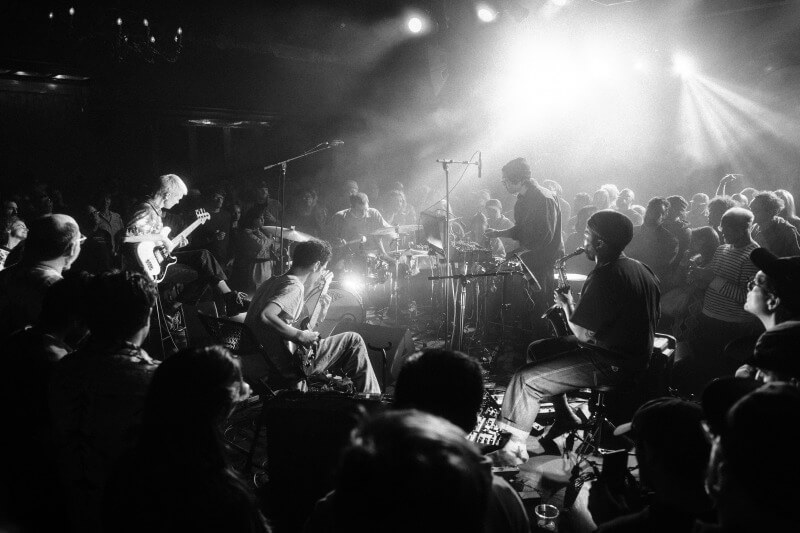
SML has since relocated to Zebulon in Frogtown, because the venue allows them to attack their preferred method of performance: “in the round, on the floor—a little bit more intimate, doing two sets that are fully improvised in our own way,” as Chiu defines it. At Zebulon, SML uses the spirit of ETA to nourish their own creativity. The band benefitted the community that the IVtet gathered at ETA, because that community has been able to follow all the artists who were involved in that space to other venues. The switchover isn’t perfect, but it’s comfortable. “Zebulon is a bigger space [than ETA]. They have higher overheads and need to bring in more people and book things that are maybe a little less experimental sometimes, to make that work,” Butterss says. “ETA worked because we were given complete free rein to play however long we wanted, what we wanted, with who we wanted.”
SML may be an LA project, but its roots are planted in the Midwest. Butterss grew up in Adelaide, Australia, but went to school at Indiana University in Bloomington, where they met Johnson and witnessed the region’s isolated geography bleed into the art being made there. “Sometimes it feels like the stuff you’re doing is not necessarily making an impact in the larger world,” they say. “I think that actually allows you to be more experimental and try different things, because the stakes are lower. LA can have this sheen to it—the pressure is on.” Chiu, Uhlmann, and Johnson all spent time in Chicago, in Jeff Parker’s orbit. Ulhmann studied at DePaul University under Bob Palmieri, figuring out the city’s emphasis on “having your own voice more than being the best player technically,” he explains. “That attitude of experimentation was encouraged, and what was exciting was people like Parker, Hamid Drake, and Rob Mazurek—people with really unique voices who were not as well-known at that time outside of Chicago. But they were heroes to a lot of people growing up there.”
Chiu says he’s fortunate to have been in Chicago when the Sea and Cake, Parker’s band Tortoise, Jim O’Rourke, and Mazurek were shaping the city, introducing young musicians to faraway ideas, like Steve Reich, tropicália, and Brazilian music. “It expanded the palette for myself, growing up in a scene where, if you’re trying to play music or be in a group, you have to find a new, deep reference that’s your own and find a way to navigate it,” he continues. “I remember, if you were going to do a cover tune for a show, you would always look for the most obscure cover to do so that the one or two heads in the audience would recognize it—versus how, in LA, I remember coming here and people were doing Peter Gabriel bands in full. It’s the opposite approach, which I love.”
SMALL MEDIUM LARGE CAME OUT in 2024 and features one of my favorite songs of this decade, “Three Over Steel”—a looping, intuitive, chromatic jazz tune that calls back to Can, Susumu Yokota, and Fela Kuti. SML wasn’t even a band when the album dropped, Chiu reveals. “In the time of that album forming, the idea of this group was also forming. We hadn’t ever played as a unit like that.” Chiu spent a lot of time in the front traversing through the album recordings, editing the tracks. Eventually everyone put a hand in and finished the thing. There’s a lot less post-production on SML recordings than you’d think. For example: what sounds like a very edited, well-cohered piece of sampling was captured and finished by Chiu almost totally live.
But SML’s live performances and recordings are two very distinct entities that inform how each member approaches the group. “When we are playing live, we’re not trying to recreate anything that was on a record,” Chiu explains. “When we’re making records, we’re trying to think about the narrative of that particular record and pull together elements that we feel capture the essence of what this thing is, but not in an entirely longform way.” All the ideas proliferate out of the live performance. Everyone in the band has a palette that is so much further-reaching than the instrument you might see in their hands, or the sound you might associate with them. When SML dove into the stems of Small Medium Large, the expressions they found on the tapes were distinct and unexpected. They couldn’t always tell who was playing what. When it was time to edit the next album, How You Been, multi-track recordings allowed everyone to reinterpret everybody’s parts. “At the shows, we’re all making decisions together,” Uhlmann says, “but when you take it home, you’re making the decisions and then bringing it to the group. It was an interesting look into people’s visions of what we’re doing live.” When Johnson brought in his “Gutteral Utterance” edit, he presented his bandmates with this shocking, inexplicable distortion of sounds.
SML leave me speechless. I find their work to be incomprehensible. Indescribable. I’ve never heard anyone make anything like it. “We’re playing intuitively together,” Butterss affirms. “We have an understanding of what’s going on and a connection in that way, but I do think it’s hard to put it into words that make sense.” SML is early Kraftwerk, electric Miles Davis or electric Herbie Hancock. It’s Cluster. It’s not a jazz band, but it also kind of is? Chiu certainly doesn’t consider his role in the group to follow the genre’s structure. “We aren’t intentionally situating ourselves in that mode,” he elaborates. Butterss, Uhlmann, and Stardrum play exceptionally well in that language, but Chiu approaches it from a much more experimental, electronic vantage—a byproduct of knowing Jim Baker’s improvisational ARP synth recordings, no doubt. “I came to it from the desire to be able to operate in a more improvised context and collaborate with different people. That’s the most important part. Being able to improvise or play off of it in ways that aren’t tethered to how we’re thinking today about modern electronic music or noise music or experimental music, but in a hybrid of all these things coming together.”
The band “grew out of improvisation,” Uhlmann adds. “Something I’m drawn to, in every musician that I play with regularly, is that their voice goes beyond the instrument. It’s like talking to someone: you’re going to have a different chemistry with different friends and different groups. Playing with a group of five people definitely feels different, and there’s more energy to bounce off of. Being in a band feels like being in a polyamorous relationship. When you bring more people in, this different chemistry starts happening and it ends up being one thing more than the individual.” The point of an improviser, Parker reckons, is to get to the stuff that you don’t know. He passes onto me a Sun Ra quote passed onto him by Avreeayl Ra: “If you start from a finite place, you’re only dealing with the things you know. But if you start from infinity, then you can go into the things that you don’t know. And you can discover new things.” SML’s music, resistant to prompt, is challenging in infinite ways.
Butterss brings a lot of what they learned from playing with Parker and the IVtet to SML. “There have been weeks with the IVtet where it feels really stuck in a rut, and that can be really frustrating,” they admit. “You have a choice: you can either sit back into your role and let it stay static, or you can push through it.” SML is always trying to push through it. “And we trust each other to capably do so,” Chiu acknowledges. “All of us are going to find a way out in an unexpected or new way. That’s why we do two nights in a row with multiple sets—because [the tension] doesn’t always hit at every moment, but that struggle is part of it.” Uhlmann concurs: “It’s always been, ‘What haven’t we done that we can find?’ Maybe you hear us finding that sometimes. It brings everyone into the same listening space in a nice way, when we’re all finding it together.” It’s like having a “musical ESP” with each other, as Chiu puts it.
After playing more shows together and revisiting Small Medium Large more often, Buttress believes that SML has a “band sound” now. “But I don’t know if any of us could individually sit down and define what that sound is,” they say. “I think we all have an idea in our heads of what our band sounds like.” It’s marvelously true, considering how spread out the members of SML so often are. Butterss has become an in-demand bandmate, touring with Andrew Bird and Jason Isbell in recent years, while Johnson works with Leon Bridges and Uhlmann (when he’s not doing improvisational guitar doubles with Meg Duffy or polyrhythmic ambient with Johnson and Sam Wilkes) travels the globe playing guitar in Perfume Genius. But they always get back to each other to break away from the fatigue and rigidity of tour setlists, of playing by routine. No two SML sets sound the same, and they never will. “I think what we’re doing right now, having an opportunity to do the thing that we love doing the most, which is play together for multiple nights, we’ve already started saying, ‘What new things can we do? What different ways can we approach this?’” Chiu says. “Without speaking about the actual music or logistics, we just bring something to the table that we’ve been investigating on our own and see how it plays into the fold. That feels really special.”
Those investigations play out in real-time onstage. And there’s tension in doing so, in on-the-fly ideas getting road-tested without pretense. “People find their roles in a group and then they’ll lean into those and stay there,” Chiu explains. “Ours are always shifting.” At a recent show, Butterss started playing bass and their bandmates just left them out there to solo. Then, Johnson came in with just shaker. “And then I was like, ‘I’m joining Josh on shaker,’” Chiu remembers. “It puts you in a position to be like, ‘What’s happening now?’ All of us are feeling that tension. Then you listen back and you hear it… That’s so special, because it forced somebody to make a decision in a different way. We’re always trying to push that boundary a little bit. I think it’s evolving.” You can’t always hear that on SML’s records, but it’s there—like the break in “Taking out the Trash,” where Uhlmann and Stardrum come in hard on Chiu and Butterss’ beat, which Butterss can only define as shzoop.
Think of SML as freakout code-writers. “Taking out the Trash” begins like a pulse in a cut, with Butterss’ crunchy bass lyrics colliding with Stardrum’s snare just beneath it. Then, Uhlmann’s skronking guitar chimes in before the whole thing erupts into a voice that streaks in every way but parallel. The lights dim on “Mouth Words” and the Uhlmann’s caveman, Neil Young-style beat and Butterss’ ostinato bass line turn on. There’s the call-and-response between Uhlmann and Johnson in “Daves”; the Krautrock daydream of “Moving Walkway”; the reverb surroundings engulfing “Brood Board SHROOM”; the poked, prodded, and manipulated tape sounds in the aptly-titled “Gutteral Utterance.” How You Been sounds cohesive, tethered—even in the madness of its kosmische, house, acid, Afrobeat, and techno chaos, where theory and feel get synthesized into mind-melting overtures of pedal tones, modules, and DAWs.
But I’m most drawn to how alive “Chicago Four” sounds, with Johnson’s sludgy horn shots and Chiu’s calibrating synth passages that play a song of their own. SML brings new meaning to the idea of a “collective.” Everything they do is in lockstep with each other, even when the music sounds like every member is doing something totally different inside it. “Chicago Four” reveals an almost hypnotic loop of contrasts. It’s as much an industrial synth-pop song as it is a jazz-funk lick. The music is all over the place yet never out of chemistry or sync. Improvisation is essential to SML, but there’s gotta be a word for whatever exists beyond that. The shared human impulse between Anna Butterss, Jeremiah Chiu, Josh Johnson, Booker Stardrum, and Gregory Uhlmann is one of a kind, impossible to replicate.
Matt Mitchell is Paste’s music editor, reporting from their home in Los Angeles.



 Keep scrolling for more great stories.