The trek to Los Angeles in search of fame is a tale as old as the entertainment industry itself. It applies to everyone from Neil Young to Emma Stone to the Hype House. But as the story goes, success has a price. Sooner or later comes the dark underbelly: a crumbling of the self, the psyche, the vision, the morals. Oh, calamity! Please, tell me who I am! In 1977, coming off the high of a flourishing 3-album run (Crime of the Century, Crisis, What Crisis?, Even in the Quietest Moments), British rock group Supertramp had enough momentum to make the jump across the pond, pushed by A&M Records to cash in stateside. 1979’s Breakfast in America is informed by two formative years, as Rick Davies and Roger Hodgson’s artistic impulses and creative philosophies continued to diverge. Where Hodgson dove into health and spirituality, Davies remained gritty and skeptical. The fault lines deepened.
That mismatch is at the core of every track. The two worked independently, each contributing five songs to the final Breakfast in America tracklist. What could have easily collapsed under quiet resentment and industry demands became one of the most impactful and hit-rearing albums in all of rock. It’s a prog, pop, quasi-opera, and jazz mega-opus full of mini-epics and an absurd hits-per-album ratio, ushered into the fold by two of the most distinct vocalists of their time and complete with the most lasting and hypnotic riffs of the 1970s.
Something I only noticed recently is how Breakfast in America’s instrumentals mirror the band’s internal split. The palette alternates and supplements rather than fighting to overpower. Davies blends and fuses his Wurlitzer and piano, while trading Hodgson’s guitar for the occasional harmonica or woodwind, giving the album a jazzy undertow that keeps the brightest songs on edge (on the 7-minute closer, “Child of Vision,” the keys and the Wurlitzer circle each other in mirroring melodies, coming to an overflowing finish). That versatility is a breeding ground for standouts and classics of all forms. Between “The Logical Song,” “Goodbye Stranger,” “Take The Long Way Home,” and the title track, Breakfast in America could function in part as a Greatest Hits mix.
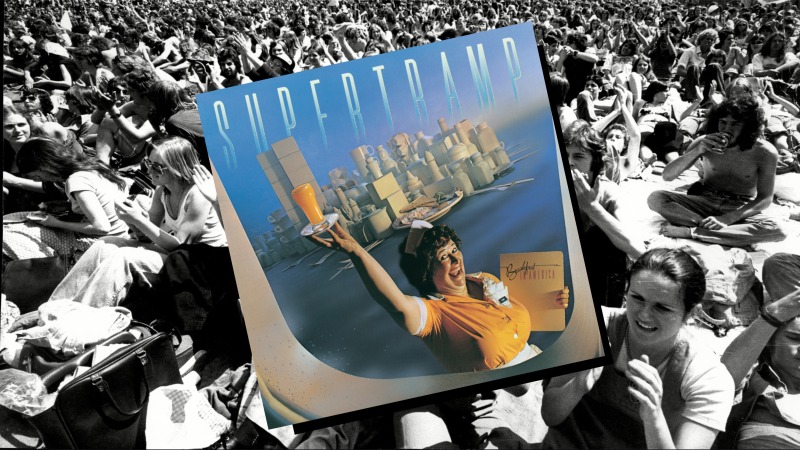
Supertramp more or less brushed off the notion that Breakfast in America was a concept album about American commercialization or identity erosion, but it’s hard not to hear those themes echo. The cover alone (Libby, the megalophobia-inducing waitress/Statue of Liberty stand-in, propped in front of a skyline built from silverware and kitchen utensils) frames the album as a funhouse-mirror rendition of the American dream. Maybe Supertramp was worried that openly critiquing American culture would alienate the very audience they were courting. Add it to the list of things sacrificed in the name of success.
Breakfast in America is inherently autobiographical, opening with a double-shot of disillusionment captured at the Village Recorder in Los Angeles. The keys are strident and prickly, splicing through the emptiness of the album’s first few seconds. Davies’s guttural, almost whiny “Ain’t nothin’ newwwwwwwww / In my life todayyyyyy” gives way to the brewing frustrations with the mundane, when the special has become the routine. As if to say, “I thought this would be fun, but now I’m a shell of something in the name of success,” over a bed of ever-tightening keys.
Hodgson’s dulling-of-the-self harkens back to his boarding school days on “The Logical Song,” which finds him turning from the beautiful and magical to the clinical and cynical. He spits at both the music industry and its consumers, the people who prefer someone acceptable and presentable over liberal and fanatical. Regardless, it’s a sanding down of identity to the point where you need someone to tell you who you are. Throughout, Hodgson flexes his ever-satisfying intonation and delivery, “vegetable” and “radical” rolling off his tongue with a pseudo-European flair, giving it a musical-theatre lean that makes it feel like he’s stepping into a hyper-amplified version of himself. “Take the Long Way Home” is the product of a career of identity-blurring performance, the winding journey of figuring yourself out. The song’s second-person POV directs the story onto the listener, but in one of those defeated but comforting “we’ve all been there” tones. The lyrics are bluntly simple, their sting dropping in a half-beat late, like subtitles just out of sync (“And then your wife seems to think you’re part of the furniture / Oh, it’s peculiar, she used to be so nice”). Hodgson’s harmonica blends with John Helliwell’s saxophone, taking on an emotive, stirring melody of its own in place of a guitar solo. It’s a mix of despair, acceptance, crisis, and melancholy, all disguised as whimsy, quietly meandering into an existential-but-ebullient unravelling.
The title track’s flouncy, bouncy instrumentation doubles down on that playfulness while still hinting at a teetering internal psyche. Lines like “Could we have kippers for breakfast / Mummy dear, Mummy dear?” and “I’m a winner, I’m a sinner / Do you want my autograph? / I’m a loser, what a joker” are delivered in the same verse by a narrator trying to decide between bragging and begging for reassurance. The bum-bum-bum of the horns and the curt, soft-spoken “Hey!”s in the chorus add a kind of cheerful theatricality. Even the poppiest tracks twitch beneath the noise.
“Goodbye Stranger,” one of the oft-needle-dropped tracks that many are born knowing the melody of, carries the same sentiment—whether Davies is talking to Hodgson or to a one-night stand: it’s been nice, wish you well. The wooshing and flanging guitars feel airborne, unfurling at the close into a disorienting, berserk whirlpool (an anomaly on a record otherwise defined by jagged optimism). It immediately plops you back into childhood; suddenly, I’m three years old on the carpet in my family’s den while Dad blasts Davies’s vaulted falsettos. “Goodbye Stranger” says farewell with a smile—“Hope you find your paradise!”; “Hope your dreams will all come true!”—while maintaining a kind of broadly omniscient composure (“Now some they do and some they don’t / And some you just can’t tell,” gives a defeated, “Whelp, that’s life” shrug). It’s the blippy, light, sweetly off-putting sonic equivalent of slowly backing away from someone, smile frozen in place. Repeat “Feel no sorrow, feel no shame / Come tomorrow, feel no pain” and you might actually talk yourself into some inner peace.
That tension exists without knowing the band’s biography. You can just hear it in the jumps in sound, the polar-opposite qualities of their vocals or song structures. Davies is looking at Hodgson, but Hodgson is also looking at Hodgson. Take Davies’s “Casual Conversation,” which feels like all but a direct callout to his and Hodgson’s dynamic: “There’s no communication left between us / But is it me or you, who’s to blame / There’s nothing I can do, yes, you’re fading out of view.” Davies has already said his piece, resigned to the stalemate. Hodgson’s “Lord Is It Mine” is introspective, a piano ballad in which he expresses how tiresome conflict is. He looks to God for guidance and lays bare his need for solitude (“You know I get so weary / From the battles in this life / And there’s many times it seems / That you’re the only hope in sight”). He’s talking to himself, but he’s still offering up a depth of emotion that is meandering and ever-changing. Davies is matter-of-fact, unaffected.
More often than not, Breakfast in America is taken at face value, recognized for its hits alone. And while those songs are undeniable and lasting, looking deeper reveals a record about both losing and finding yourself. That “self” is in constant flux, Davies doing much of the losing and Hodgson predominantly searching. The music follows that instability, their wavering identities showing up in the turns and tangents, deftly woven into Supertramp’s most commercial instincts.
Listen to Supertramp perform at Royal Albert Hall in 1977 below.


 Keep scrolling for more great stories.