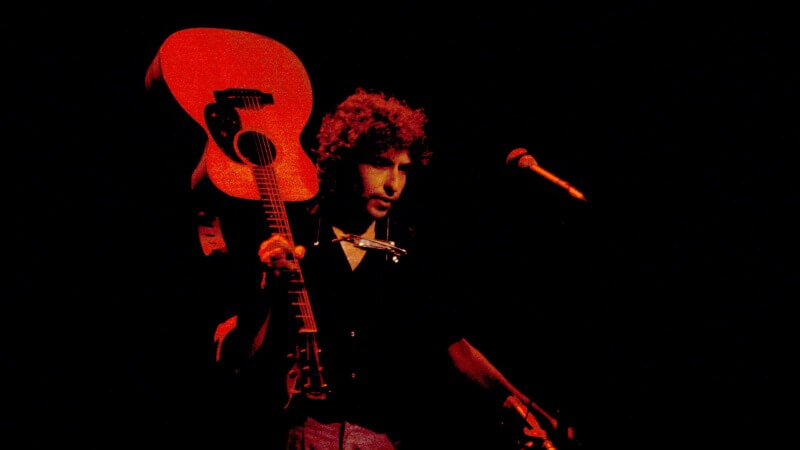
Bob Dylan remembers the exact moment Jesus Christ entered his life in a way he could not ignore. The physical and emotional tolls of the road had proved exhausting on his 1978 tour. On one particularly draining night in San Diego, the singer recalls an audience member tossing a silver cross onstage. Dylan normally wouldn’t think twice about this sort of trinket but felt moved that night to pocket it. A couple nights later in Tucson, once again feeling overwhelmed by the burdens of performing, he reached for the cross and felt a trembling, physical change come over him. As Dylan interpreted it, “The glory of the Lord knocked me down and picked me up.” While the I-10 from Tempe to Tucson may not exactly be the Road to Damascus, the experience shook Dylan enough to “change his way of thinking” and embrace Christ as his lord and savior. It’s an awakening that would not only transform Dylan’s personal life but also unmistakably alter the path, for better or worse, of his already-legendary career as a songwriter, performer, and recording artist.
Dylan’s conversion was definitely met by mixed reviews. While some in the evangelical community championed him as their new Daniel—though never to the extent that the folk scene had embraced him as one of their own—much of his fanbase felt alienated by this religious turn. Ironically, many of the same people who had once anointed Dylan their “prophet” now had little interest in hearing about the singer’s own exploration of faith. In fairness though, the changes seemed drastic. For a time in 1979 and 1980, Dylan staunchly refused to perform the secular songs that had made him famous. And as bootlegs capture, those concerts took on the aesthetic of big-tent revivals, with Dylan often proselytizing onstage between songs with a reborn zealot’s zeal. It also didn’t help that Dylan’s own trinity of Christian albums—Slow Train Coming (1979), Saved (1980), and Shot of Love (1981)—fell far short of his finest works. However, these records also don’t deserve to be omitted or cruelly cast into the purgatory that is the lowest rungs of online Dylan album rankings. In this charitable season, we can surely appreciate that even one of the spottiest and most maligned eras of Dylan’s recording career still captures moments of powerful songwriting, fearless artistry, and a passion that cannot be denied.
The story of Dylan’s trio of Christian albums begins not some 2,000 odd years ago, but rather a year earlier with the release of Street-Legal in 1978. You could do far worse than characterizing this often-overlooked gem as Blood on the Tracks with saxophones and gospel singers. No, it’s not a religious album. Dylan mentions God only in passing. However, it’s clear that Dylan was tangled up in one shade of blue or another at the time. Despondent over the failure of his experimental film, Renaldo and Clara, and weary from the stresses of multiple knock-down, drug-out custody battles, Dylan and his touring band instead leaned into an expanded pop sound that American audiences, particularly critics, weren’t quite ready to embrace. It’s a record that captures Dylan setting out in a brave, new musical direction as his personal life came crashing down around him. By the time he hit that fateful road to Tucson, Dylan was a troubled man with a heavy heart and a crack R&B band burning a hole in his back pocket. In that sense, it’s far less surprising that Dylan, perhaps with a little nudge from Above, might have found solace, purpose, and renewed strength in the spiritual corner and its musical traditions.
By any measure, 1979’s Slow Train Coming proved a successful baptism into the religious realm. The album went platinum, and Dylan even garnered the inaugural Grammy award for Best Male Rock Vocal Performance. It’s fair to wonder how many fans who purchased the record really knew they were getting a born-again Dylan. The album art itself, apart from that railroad worker’s suspiciously cross-shaped pick axe, doesn’t suggest overtly religious material. Even legendary producer Jerry Wexler and Dire Straits guitarist Mark Knopfler—both brought aboard to help achieve the record’s larger funk sound—didn’t realize that they had been conscripted into Dylan’s evangelical army until rehearsing the actual songs. Dylan does indeed remind us over the throbbing funk of hit single “Gotta Serve Somebody” that we’re all working for someone (“It may be the Devil / Or it may be the Lord”), but this choice of master never really felt literal. And doesn’t a “slow train comin’” just mean “a hard rain’s a-gonna fall?” Naive as it now sounds, the lapsed Catholic in me could once listen to songs with titles like “Precious Angel” and “I Believe in You” and hear Dylan’s passion but not “the message.” If that’s a common sentiment, then it goes a long way to understanding the record’s accessibility to a presumably large secular audience. Having Wexler at the helm, Knopfler on lead guitar, Tim Drummond’s legendary bass, and Muscle Shoals horns on call didn’t hurt either.
As we’ll see, each of Dylan’s Christian albums takes on a decidedly different religious tenor. Nick Cave has described Slow Train Coming as a “mean-spirited… genuinely nasty record.” It’s at the very least cynical. Some of that can no doubt be chalked up to the fervor felt by a recently reborn Dylan. For instance, the flip side of the succor an emotional Dylan draws from on high in the stirring ballad “I Believe in You” pits the nonbelievers around him as heathens with pitchforks. Not exactly a neighborly sentiment. Much of Dylan’s message takes a page out of the Book of Revelation, meaning that time runs too short to politely pull punches. The chugging “Slow Train,” filthy-riffing “Gonna Change My Way of Thinking,” and horn-driven “When You Gonna Wake Up” all call out the overflowing cesspool of greed, deceit, and corruption found in a wicked world that defies God’s law; they also point more fingers than Dylan has on both hands. However, nowhere do Cave’s words ring truer than down in the fire and brimstone that fuel the glowing strum of “Precious Angel.” Not only does Dylan work in the torments found in Revelation 9:6 of those who won’t even be able to escape their suffering through death, but he also prays for the mercy of his own ancestors (“In their bone-filled graves”) who may have picked the wrong spiritual team. To the evangelical, Dylan’s warnings register as dutiful and loving. To the secular listener, they might come across as, well, “mean-spirited” and “genuinely nasty.” Point, Nick Cave.
If Slow Train Coming surprised some listeners with a religious perspective on what could’ve otherwise been Dylan’s What’s Going On, then Saved makes zero pretenses as it ascends to the pulpit. The original cover, since restored, features Christ’s illuminated hand, blood dripping from a crucifix wound, reaching down to touch the outstretched hands of his followers. It’s not exactly a subtle image. Critics have dragged this largely forgotten album as preachy, too limited in scope and song structure to be interesting, and a hackjob stab at gospel music.
Saved might also be the best of Dylan’s Christian albums for almost the same reasons. This record knows exactly what it’s trying to be. It’s Sunday services at a church far cooler than the one your parents dragged you to all those years ago. Dylan’s humming cover of the old country song “A Satisfied Mind” acts as a call to prayer, a pewful of female gospel singers and clunky piano floating in and out to raise up his assertions. Similarly, the funky call-and-response of closing number “Are You Ready” feels like a fortifying final reminder of the day’s sermon before Dylan sends us back out into the regular world. In the interim, he marches us with growing awe through the latter stations of Christ’s life (“In the Garden”), invites us to dance in celebration as we praise (“Saved”), and asks us to consider where we would be without Christ’s sacrifice (“Saving Grace”). Indeed, it’s pedagogical, repetitive, and, yes, even preachy, but along with hoping to stir the soul, sermons are intended to reinforce a message as Dylan does here.
One fair criticism of Saved and other songs from the period considers how Dylan’s writing might suffer as he draws from revealed truth rather than trying to make his own meaning out of human experience. On the grateful “What Can I Do for You?”, Dylan even thanks God for answering life’s great questions (“You have explained every mystery”). If he had spent more than a few years writing Christian songs, he might’ve fallen victim to these limitations. As it stands, Saved finds Dylan delivering some powerful, if sadly neglected, numbers as he draws inspiration from scripture and borrows from adjacent musical traditions. After the physical elation of “Saved,” “Covenant Woman” returns us to our seats to cool down as a once hurting Dylan (“broken, shattered like an empty cup”) thanks a righteous woman for her guidance. The chorus of this contemplative strummer features one of Dylan’s more moving vocal turns, once again assuring us that born-again Dylan still shoots from the heart. The pummeling “Solid Rock” later shakes the stained-glass windows and rattles the pews with muscle to match the strength that Christ imbues in his followers. But nowhere does Dylan’s conviction reach greater heights than as he testifies over piano and gospel backing vocals on the adamant “Pressing On.” Here, Dylan calls out the doubters and lets all of us know that his heart has truly changed, and there’s no turning back. Like Saved in general, it might be too much of a sermon for some tastes, but damn if it doesn’t make you want to drag your ass back to church this Sunday and throw on a choir robe.
Shot of Love ranks by far as the most perplexing volume of Dylan’s Christian trilogy. It also subtly suggests that Dylan might already have one foot out the door as a strictly religious artist. Most of the gospel elements have been abandoned in favor of a return to a more traditional rock sound. Songs like “Heart of Mine,” featuring no less than Ronnie Wood and Ringo Starr, the reggae-flavored “Dead Man, Dead Man,” and the cool breezes of illusive outtake “Caribbean Wind” all hint at the island vibes that would turn up on 1983’s Infidels, Dylan’s ironically titled official return to secular music. Gone are the apocalyptic foreshadowing of Slow Train Coming and the evangelical pageantry of Saved. Instead, Shot of Love embraces a sort of pop-art Christianity to match its explosive, Lichtenstein-indebted cover art. As suggested by the album’s title, Dylan has love on his mind here. But not the “Watered-Down Love” that too many pursue or the type that could lead one astray (“Heart of Mine”) if you foolishly let it in. No, Dylan needs that all-powerful “Shot of Love” for what ails him. But this big, dumb title track, along with a song like “Property of Jesus,” sounds more like a bumper sticker or an evangelical highway billboard than a true examination of the power of God’s love. Throw in a song that addresses Lenny Bruce as a Christlike figure, and it gets close to time to line up another type of shot just to swallow this weird album.
Still, for all its peculiarities and lazy evangelical sales pitches, Shot of Love also features some of Dylan’s best songwriting of the ‘80s. The breezy, affirming “In the Summertime” plants at least one foot in the secular sand with its focus on a cherished human connection that feels no less spiritual than anything spoken of on Saved. Dylan’s harmonica perfectly compliments the proceedings as it gently wafts in and out to guide us through time, love, and memories. “The Groom’s Still Waiting at the Altar,” criminally left off the album’s original release, lumbers like a dusty, archaic beast resurrected from the cutting room floor of the Blonde on Blonde sessions. Dylan summons all his gravelly powers as a singer as he spits absolute fire from the doorstep of “Claudette” to just east of the Rock of Gibraltar. Outtake “Angelina,” like the previous examples, attempts to straddle the religious and secular worlds. It’s the type of undefinable song that can morph with each listen but definitely finds a conflicted Dylan trying to reconcile his heart with his faith. “I tried my best to love you / But I cannot play this game,” he sadly concludes. “Your best friend and my worst enemy is one in the same.” Again, there’s as much drama in this all-too-relatable dilemma of being on different spiritual paths as anything Dylan pulls from scripture. Dylan bids farewell to his Christian era with the absolutely sublime closer, “Every Grain of Sand.” It’s a poignant and soul-baring reflection on both the wonder and majesty of creation and a relationship with the numinous that turns inward as much as skyward for answers. Dylan has never penned anything lovelier.
Not even during this profound time in the liturgical year would I expect Dylan’s flock to return to his Christian albums let alone become converted into fans of them. At this point, that feels like a miracle on par with anything you’ll find in Christ’s string of greatest hits. When we speak of great devotional artists—painters, poets, and even composers—we can’t number Dylan among them. While his brief foray into Christian themes matched a deft hand at assimilating different spiritual and musical traditions with an undeniable sincerity and alacrity, this period rarely inspired his true genius as an artist. Still, the generations keep coming, and there are always new stones to turn over in a body of work as sprawling as the one Dylan has amassed and bequeathed. If there’s anything I’ve learned, it’s that there’s always a chance to catch a glimpse of a masterful hand—in any Bob Dylan album or song just as in every grain of sand. So, hang on to that solid rock this holiday season, and keep a weather eye out for that slow train “comin’ up around the bend.”


 Keep scrolling for more great stories.