[Editor’s note: This piece contains spoilers for The Lowdown’s finale.]
One of the most striking aspects of Sterlin Harjo’s TV shows is their inherent sense of place. In Reservation Dogs and now The Lowdown, his home state of Oklahoma takes precedence and becomes a potent part of the story. In the former, which he co-created with Taika Waititi, there’s a palpable energy to the fictional town of Okern (filmed in Okmulgee), where Rez Dogs‘ four teens grew up together andembark on their coming-of-age journey while mourning a fallen friend. The show immerses you in their world from the opening scene itself, where they steal a truck full of Flamin’ Flamers, to the insightful exploration of their homes, families, the local Indian Health Clinic, the church, and more. Initially desperate to escape what they view as confines, the teens grow to value their community and cultural history over three seasons. Harjo retains the thematic through-line in his latest FX series, which wrapped up its first season on November 4.
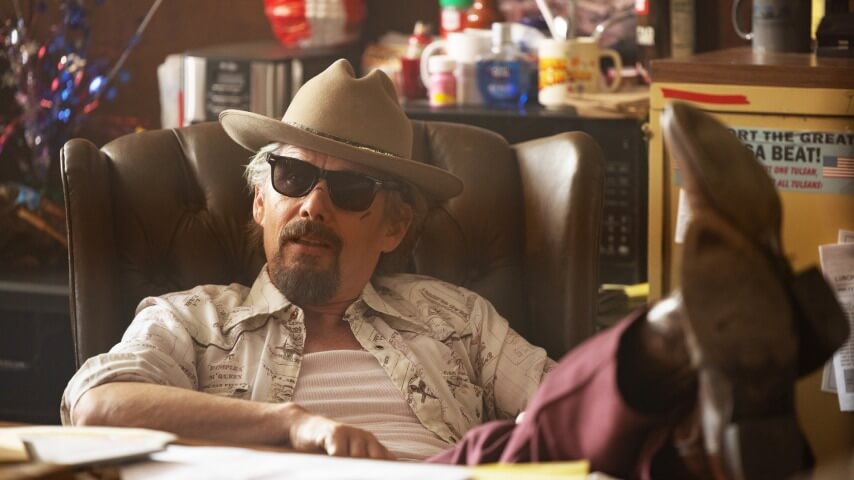
The Lowdown couldn’t be more narratively different, but it still ends up as an earnest homage to his Native American roots. (Both shows feel immediately lived-in and share a similar visual aesthetic, brought to life by production designers like Brandon Tonner-Connelly and art director Andy Eklund.) Here, self-proclaimed “truthstorian” Lee Raybon (Ethan Hawke, who guest-starred inRez Dogs‘ penultimateepisode) has a penchant for landing in trouble, thanks to a persistent investigation into Tulsa’s corrupt politicians and businessmen. It’s a small price to pay to pursue justice, earn a paycheck, and impress his daughter. Like Rez Dogs‘ young protagonists, Lee’s identity is intrinsically shaped by those around him, evidenced by his connection to the residents and neighbors. So part of his mission is to help them, which in this case means solving the murder of a closeted Dale Washberg (Tim Blake Nelson), who seemingly shot himself after Lee published an exposé about his family. Through this mystery, Harjo continues to interrogate the restorative power of shared history and generational bonds.
Of course, TV isn’t the only medium through which Harjo has analyzed this clearly personal subject matter. His Oklahoma-set films like 2007’s Four Sheets To The Wind, and 2009’s Barking Water centered his tribe, the Seminole Nation, while 2015’s thriller Mekko takes place in Tulsa, and follows a recently released prisoner who reflects on his past and ancestors while coping with his actions. But in the episodic format, Harjo digs deeper into Indigenous history and its connection to the present day. In Rez Dogs, this was achieved through surrealism and collective healing as Elora (Devery Jacobs), Bear (D’Pharaoh Woon-A-Tai), Willie Jack (Paulina Alexis), and Cheese (Lane Factor) grieve the death of their pal, Daniel (Dalton Cramer), with the help of their loved ones. The Lowdown focuses more on the Indigenous displacement in the city and how that has changed the community at large. And it all comes to a head in a satisfying, sentimental finale.
In “The Sensitive Kind,” Lee finally learns that Dale’s accidental death was caused by two skinheads. All they had to do was threaten him so he wouldn’t bequeath the Washberg land to its rightful owners—the Native American grandfather-grandson duo of Arthur Williams (the late, great Graham Greene) and Chutto (Mato Wayuhi). The people who masterminded this whole scheme were Dale’s wife, Betty Jo (Jeanne Tripplehorn), and Frank Martin (Tracy Letts), the racist owner of a construction company called Akron. The Lowdown spent season one revealing how Akron was buying up Black-owned businesses in town to “flip them.” More curiously, Frank was about to purchase the Washberg land with a right-wing pastor. The money was going straight into the campaign of Dale’s brother, gubernatorial candidate Donald (Kyle MacLachlan), who was unaware of how Dale died.
Once Lee lets Donald know everything that went down with his brother, the older Washberg sibling fulfills Dale’s wishes and rights a grievous historical wrong. At a press conference, as Lee looks on, Donald announces that the land will be gifted in its entirety to the Osage Nation, adding that “[Oklahoma] does not exist without the great tribal nation, and it does not operate correctly unless the state government recognizes tribal sovereignty.” On a micro level, is this Donald’s blatant bid to secure votes without the specter of Frank and his associates over his head? Yes. But on a macro level, Harjo and the show’s writers’ room reflect oncenturies of trauma, resilience, and kinship of the Indigenous community.
A shared sense of community drives “The Sensitive Kind” when Lee’s allies, like Keith David’s Marty and a group of locals, sneakily guide Donald into his office for their pivotal conversation. The show also emphasizes how, without the help of folks like Marty, antiques dealer Ray (Michael Hitchcock), Lee’s bookstore clerk Deidra (Siena East), and his own kid, Francis (Ryan Kiera Armstrong), Lee wouldn’t have been able to get to the truth. Like Rez Dogs, The Lowdown doesn’t paint a glossy picture, but depicts an expansive, layered community. As Harjo told The New York Timeslast month, “I’m trying to put onscreen my ideas of what my home is.” There’s no word on The Lowdown‘s return, but the creator’s next projects (including an adaptation of the Canadian podcast Stolen, about an Indian Residential School, and writing a script on Native American gold medalist Jim Thorpe, and even a potential Spider-Verse spin-off) will hopefully continue to expand on the same ideas in ever more inventive ways.


 Keep scrolling for more great stories.