A movie that makes it onto The A.V. Club‘s best films of the year list probably also includes at least one of the best scenes of the year. But a film also doesn’t need to be an indisputable success as a whole to have at least one moment that sticks with you months after catching it in theaters. These were the principles guiding our staffers as they picked the best film scenes of 2025, picking out sequences from the year’s very best and the very best scenes from the rest in order to highlight the standout showstoppers that personally affected us the most. Some of these are undeniable—any list like this out there this year that skips over the time-distorting dance magic of Sinners can’t be trusted—but others are wild cards, picked because they spoke to the individual writing them up. Whether that means that they injected a blindsiding amount of pathos into a silly whodunnit, added a little steaminess back into cinema, or just paid off a harrowing horror movie in the most cathartic way possible, they leapt from the screen when so many of their peers were retreating to inoffensive safety. Here are our picks for the best film scenes of 2025.
When looking to cast a joke character who isn’t actually a joke, is there a better possible choice, in 2025, than Somebody Somewhere‘s Bridget Everett? Rian Johnson’s latest Knives Out whodunit suggests definitively not, as Everett’s construction equipment rental employee Louise transforms from an obstructive comedy beat into a real person with five agonized words to Josh O’Connor’s harried priest-turned-detective’s-assistant Father Jud: “Will you pray for me?” And, just like that—and with a quick glance at a smashed ceramic Jesus—the ideas about grace and religious value that Johnson has been building the entire spine of Wake Up Dead Man around come into perfect focus, as Jud pauses for half a second before turning his back on eccentric detectives and missing inheritances alike, and re-devotes himself to the work he was actually put on this planet to do. From a plotting point of view, you could lose the whole sequence without touching the film’s inevitably twisty conclusion, which sees even a charming cipher like Daniel Craig’s Benoit Blanc humbled by Jud’s act of love. But from a spiritual and emotional perspective, not a single goddamned thing in the movie would make a lick of sense without it. [William Hughes]
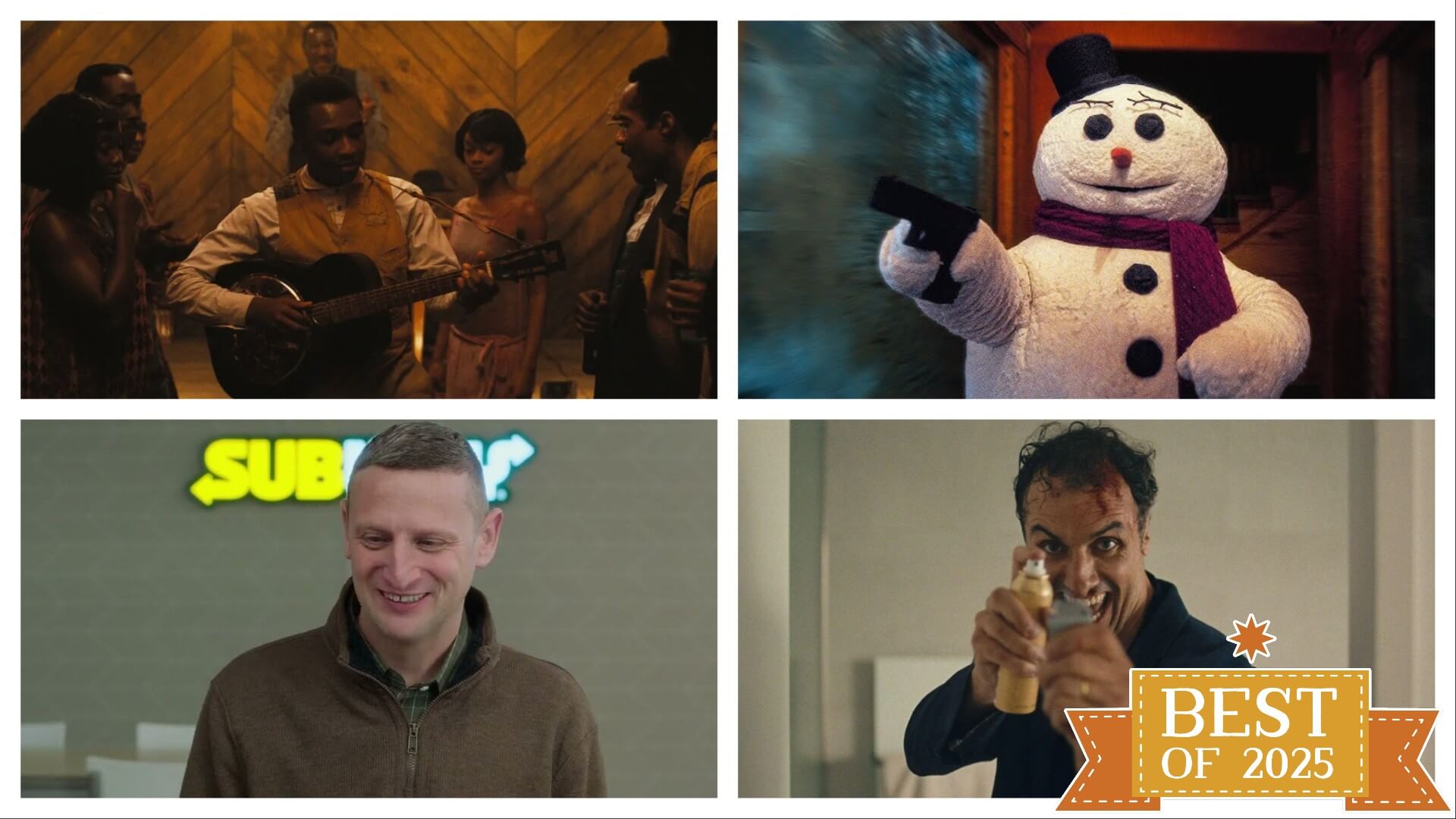
This is the scene that united audiences in every IMAX theater across the nation, Ryan Coogler thrusting them into a liminal state of ecstasy where the past, present, and future of the blues danced together in a musical melting pot that showed off everything that America could be—right before Sinners reminded everyone of what America actually is. Afrofuturist electric guitars wail and turntables scratch as b-boys and Acholi dancers pop in and out of a long, goosebump-inducing tracking shot. Chinese operatics, Black ballet, and Memphis Jookin literally burn the house down as Miles Caton shouts “I Lied To You” through the hole in the roof all the way to the heavens. It’s a spiritual moment of cultural interconnection, rooted in Sinners‘ interest in legacy and in the malleable nature of Americana. It’s also a heck of a jam. [Jacob Oller]
Friendship‘s toad lick, like so much of the comedy, requires intense buildup toward an anticlimax. It’s a drug trip so banal that it barely qualifies as a mind-altering experience, ingeniously heightening through de-escalation. After blowing up his marriage, career, and friendship with Austin (Paul Rudd), Craig Waterman (Tim Robinson) turns to local cell phone/psychedelic toad dealer T-Boy (Billy Bryk). For $100, Craig enters the mundane dreamworld of his uninspired psyche: an empty, overlit Subway restaurant. When he awakens in the Subway, that desire for catharsis or meaning grows stronger. The scene’s hazy editing and simple effects make Craig’s journey feel endless and hallucinatory, as if we might reach some greater understanding. But it’s a typical trip to Subway, albeit with Austin behind the counter, looking years older but still providing reassurance and validation toward Craig’s order. (Isn’t that all he really wants?) Sadly, before receiving his Black Forest ham on Italian herb and cheese, toasted, Craig returns to the land of the sober, lying on the floor of the cell phone store’s backroom. “Did you get the answers you were looking for?” T-Boy asks. “No, I ordered a sandwich at Subway!” The toad is mysterious, indeed. [Matt Schimkowitz]
The second collaboration between pals Michael Angelo Covino and Kyle Marvin after The Climb, Splitsville is filled with charmingly neurotic relationship satire, lived-in character dynamics, and disarmingly funny dialogue. It also boasts the single most impressive fight scene of the year, secreted away inside this talky non-monogamy comedy. Covino and Marvin, decidedly not athletes or fighters or stuntmen, break out the wrestling moves and scrappy slapping during a conflict that goes from playful to murderous and back again. In the process, a lake house is torn asunder, eyebrows are burned off, and innocent pet fish are rescued from certain death. There are no stunt doubles. The guys who wrote the movie actually jumped out a window for this. This allows the fight to have the flow of a single-shot sequence (no need to hide anyone) while incorporating the flexibility and clarity that coverage can offer. The result is as kinetic and capable as anything out of the Chad Stahelski school of stunts, with a little Jackie Chan silliness thrown in for good measure. [Jacob Oller]
There’s no way that Cho Yong Pil’s “Red Dragonfly” won’t be embedded in your brain after devouring No Other Choice. Park Chan-wook deploys this popular South Korean song in one of the film’s most dizzying moments: After mentally and physically preparing himself for days, Man-su (Lee Byung-hun) attempts to actually kill Beom-mo (Lee Sung-min), one of the men competing for the same job as him. When Beom-mo’s cheating wife accidentally enters the room at the same time, the three of them engage in an action-packed fight that’s darkly comedic, anxiety-inducing, and totally nuts—with an unexpectedly poignant conclusion. This scene not only feels like a payoff to the momentum No Other Choice has built halfway through, but also propels Man-su off on an even more bizarre trajectory for the rest of the film. [Saloni Gajjar]
Michael Shanks’ body horror Together has plenty of scenes that will make you want to throw up, but none more so than when Millie (Alison Brie) and Tim (Dave Franco) are in a bathroom stall at the school where she teaches. Utterly uncomfortable to watch, it paints a full picture of just how screwed the couple is and the many ways in which they’re about to experience pain. After they fight and engage in some steamy makeup sex, the two find their genitals literally stuck together. Trapped in a sticky situation, Together uses this violently graphic and funny scene—compounded by the claustrophobia of that tiny school bathroom—to remind us of the complete disaster that Millie and Tim have found themselves in. [Saloni Gajjar]
2025’s Superman moves faster than a speeding bullet. Writer-director James Gunn rarely slows down to hold the audience’s hand, more often than not trusting his audience to keep up. But when the film slows down, Gunn makes it count, picking a five-tool scene that can serve several masters at once. This is best exemplified about 20 minutes into the film, when Lois Lane (Rachel Brosnahan) lands her exclusive interview with Superman (David Corenswet), offering the film’s most substantial bit of dialogue and a chance to see Corenswet’s range as both Clark and Superman. As Lois grills Clark about his secret meeting with the Boravian president (Zlatko Burić), Gunn captures the current state of Lois and Clark’s relationship, her professional and ethical frustrations with how Clark shapes world events, and how Clark would like the world to see him. It’s also a chance to get through some necessary shoe leather about Superman’s Kryptonian origins and, most importantly, how Superman feels about them. It isn’t everybody‘s third Superman this century, after all. Gunn makes that backstory integral to the character as Corenswet shows his range and Brosnahan holds the line. Gunn delivers a Superman that’s vulnerable, reactive, and human, all in a scene that hangs over the rest of the film. [Matt Schimkowitz]
Like so much of Steven Soderbergh’s marriage-drama-masquerading-as-a-spy-thriller, the most radical moment of Black Bag arrives with such a minimum of fuss that you’d be forgiven for missing it: After a full film of being set up to distrust and suspect each other, married spies Kathryn (Cate Blanchett) and George (Michael Fassbender) unravel an entire international conspiracy by the simple act of turning over in bed and talking to one another. Searingly intimate and shockingly casual, the sequence sees Soderbergh thumb his nose at a million movies’ worth of Mr. And Mrs. Smith-style dramatics, as Kathryn and George quickly compare notes, realize that they’re both being set up, and begin spinning a net to catch their adversaries without even a second of worry over potentially divided loyalties. And just like that, the audience realizes that they haven’t been watching a film about the unraveling of marital trust, but a shocking little ode to its power, as, in Fassbender and Blanchett’s hands (and smoldering gazes), allegations of treason and international intrigue become just so much foreplay. [William Hughes]
The release of tension can be a precise and delicate thing—or a glorious, giddy swing of a sledgehammer, as happens at the climax of Zach Cregger’s deliciously nasty puzzle box Weapons. Cregger has just spent the last two hours building up Amy Madigan’s “Aunt Gladys” as the smug master of reality, playing on a small town’s fears and insecurities for her own dark designs. And then, with the snap of a twig and a tiny, understated “Oh no,” that veneer of control immediately explodes. Cregger, who’s kept his Whitest Kids U’ Know impulses at bay for most of the movie, lets the dark absurdity of what follows take central focus, as Madigan drops all of Gladys’ sinister reserve and just books it through suburbia, racing for dear life ahead of a horde of third graders with no sense of self-preservation, and a magically imposed need to find her and rip her aging body to shreds. What follows is hilarious, gory, ridiculous, and above all cathartic, as two hours of dread evaporate in the light of day—and the sight of possessed 10-year-olds throwing themselves through windows with furious abandon. [William Hughes]
2025’s Naked Gun doesn’t borrow the plot from the original, but it does swipe a couple of beats. This means a “falling in love” montage to overly upbeat, inspirational pop schlock is a necessity. The original had Herman’s Hermits’ “I’m Into Something Good” for Frank and Jane’s courtship; 2025 has Jefferson Starship’s “Nothing’s Going To Stop Us Now.” It’s the perfect track for this hermetically sealed sketch, a riotous centerpiece for the comedy. Frank (Liam Neeson) and “Cherry Roosevelt Fat Bozo Eating Spaghetti” aka Beth’s (Pamela Anderson) weekend away at a snowy cabin is a masterclass in heightening and genre play, a chance to rest the police procedural parody for a detour into romance and horror. The cabin, the book of incantations, and the polyamorous snowman all work together to make absurd but logical connections. Even the Snowman’s heelturn is justified when Frank and Beth kick him out of bed. Director Akiva Schaffer even pays off tangential jokes, like Frank’s sudden asthma, a confusing, shoehorned detail at first that gets funnier with each beat. Not everything in The Naked Gun worked for everyone, but even the haters have to admit that the snowman scene was pretty great. [Matt Schimkowitz]
New Year’s Eve in a single half-hour shot, Resurrection
Those coming into Bi Gan’s first film in seven years still holding onto the hour-long 3D oner that propped up the back half of the Chinese wunderkind’s Long Day’s Journey Into Night will not be disappointed. While Resurrection‘s ambition isn’t limited to one time period, narrative, or genre, its final chapter still wants to show off. That means Bi shoots it all in a single, unbroken take, tracking the meet-cute between small-time crook Apollo (Yee) and his potential moll Tai Zhaomei (Li Gengxi) along the wrong side of the tracks, as their love story develops alongside the narrative’s sinister genre surprise. That it’s all taking place on New Year’s Eve, 1999—and culminates at the literal dawn of a new millennium—only adds weight to this Before Sunrise at the end of the world. It includes a time lapse sequence, a karaoke sequence, multiple beatings, bitings, leaps of faith, ship hijacking, and a couple of jaw-dropping bursts of frame-altering color. It’s a single, After Hours-like crazy night that actually feels like a single crazy night, because it’s shot in a way that doesn’t even leave time for you to blink. [Jacob Oller]


 Keep scrolling for more great stories.